
Restaurants live or die by whether nearby diners can find them before a competitor does, and in 2026 that search rarely starts with a phone book — it starts with a directory or a map app.
- Google Business Profile wins for baseline visibility in 2026 — claim it first, it's free and shows up in Maps.
- HometownFirst is the best business directory for restaurants that want local discovery without competing against ad-buying chains.
- OpenTable earns its spot for reservation-heavy restaurants; skip it if you run counter service.
- TripAdvisor pulls tourist traffic that Yelp and Facebook rarely reach.
- Yelp still matters for review research, but its free tier competes with paid ad placements.
Why this matters
Diners don't open a business directory for fun — they're solving a problem fast: "where do I eat tonight" or "who's got a lunch special." If a restaurant isn't listed where that search happens, it's invisible no matter how good the kitchen is.
A local business directory works differently than a review site or a search ad: it's location-first, not bid-first, so a five-table diner can show up next to a regional chain instead of getting buried under ad spend. That distinction matters more in 2026 than it did five years ago, as more diners actively search "near me" instead of scrolling a feed.
What makes the best business directory for restaurants
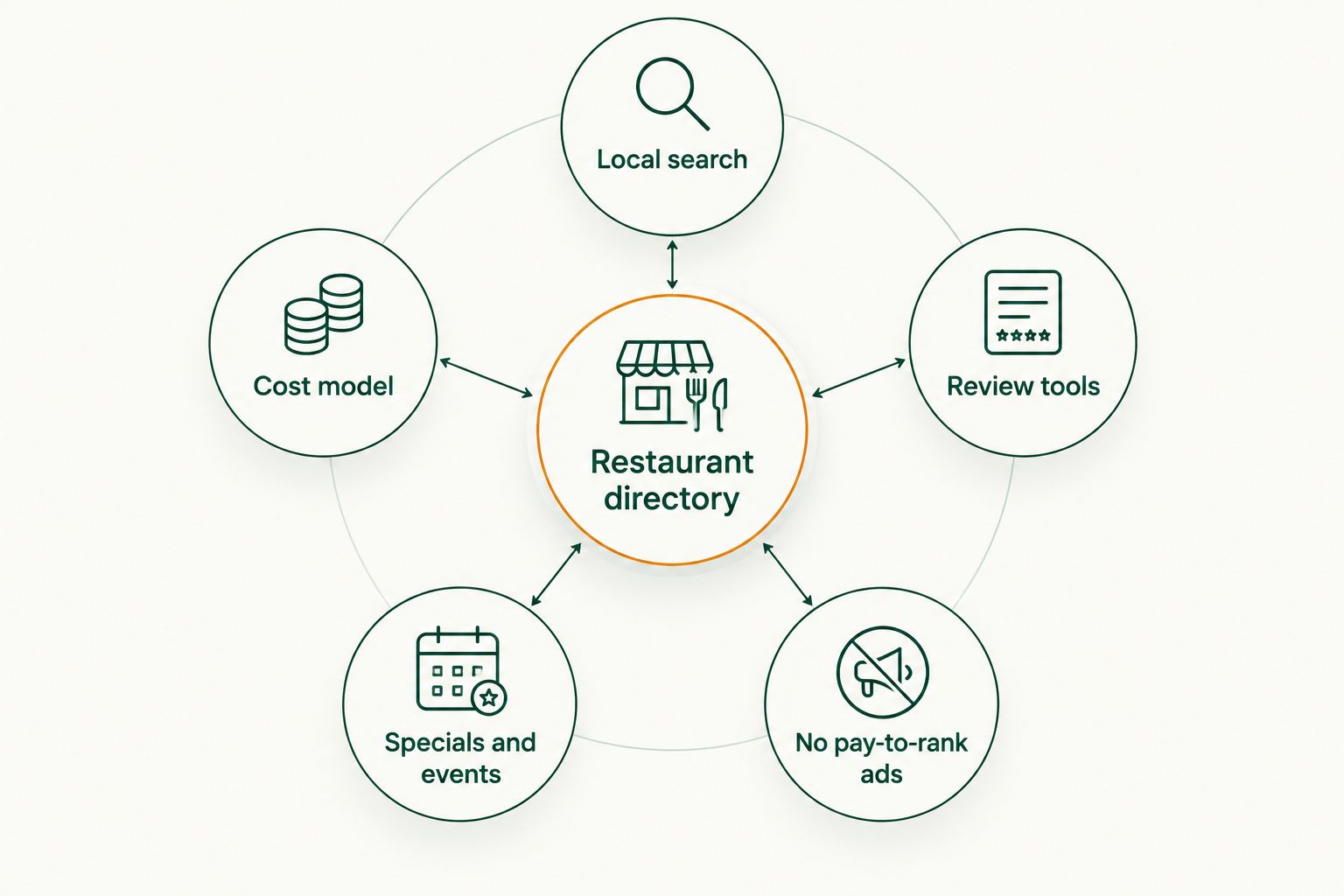
Not every directory earns a restaurant's time. Before ranking the options, here's what separates a directory worth claiming from one worth ignoring:
- Local search visibility — shows up when someone searches "restaurants near me" or browses by neighborhood, not just by keyword
- Cost model — free public listing versus paid subscription, and whether a bigger ad budget can bump you down
- Review and reputation tools — diners can leave reviews and the owner can respond publicly
- Specials and events — posting a weekend brunch special or a live-music night doesn't require a new photo shoot or a developer
- Audience match — pulls in the right diners, whether that's locals hunting a weekday lunch spot or travelers planning one night in town
- No pay-to-rank ads — placement is based on location and relevance, not who spent the most that month
Business directories for restaurants in 2026, at a glance
| Directory | Best For | Standout Feature | Key Limitation |
|---|---|---|---|
| HometownFirst | Community-first local discovery | Location-based listing with no pay-to-rank ads | Smaller footprint than national platforms |
| Google Business Profile | Baseline local search visibility | Shows up directly in Google Maps and search | Profile competes with paid ads on the results page |
| Yelp | Review-driven research diners | Deep review history and star ratings | Free tier sits next to paid ad placements |
| OpenTable | Reservation-heavy restaurants | Built-in table booking and waitlist tools | Little value for counter-service or takeout spots |
| TripAdvisor | Reaching traveling and tourist diners | Strong pull with vacationers researching a destination | Limited benefit for local, non-touristy traffic |
| Event and social promotion | Simple event pages and direct diner messaging | Organic reach for business pages keeps shrinking |
1. HometownFirst: best business directory for community-first discovery
HometownFirst is a local business directory built around finding nearby restaurants, shops, and services without wading through a wall of ads. Restaurants list their profile, post specials, and add events directly, and consumers search and browse for free.
HometownFirst pros:
- Placement is based on location, not ad spend, so a small kitchen shows up next to a chain
- Restaurants can post specials and events without a redesign or a marketing team
- Consumer browsing stays free with no selling of shopper data
HometownFirst cons:
- Smaller national reach right now than Google or Yelp, so it works best alongside a free listing on the big platforms, not instead of one
- No built-in reservation or waitlist tool
Best for: restaurants that want to reach nearby diners specifically, without competing against a rival's ad budget. Verdict: Buy — pair it with Google Business Profile rather than treating it as a replacement for one.
2. Google Business Profile: best business directory for baseline local search visibility
Google Business Profile is the free listing that determines whether a restaurant shows up on Google Maps and in local search results. It is not optional in 2026 — it is the floor, not the ceiling.
Google Business Profile pros:
- Free to claim and update
- Directly tied to Google Maps and "near me" searches
- Supports photos, hours, menu links, and review responses
Google Business Profile cons:
- Paid ads and map-pack competitors can push an unclaimed or thin profile down the page
- Review management takes ongoing attention or it goes stale
Best for: every restaurant, full stop — it's table stakes. Verdict: Buy.
3. Yelp: best business directory for review-driven research diners
Yelp built its business on restaurant reviews, and diners still check it before booking a table or walking in cold. It works best for restaurants with a track record of strong, recent reviews.
Yelp pros:
- Deep review history diners trust for research
- Star rating and price range show up in search snippets
- Filtering by cuisine and neighborhood is mature and well used
Yelp cons:
- The free tier sits next to paid ad placements from competitors
- A handful of bad reviews can outweigh years of good ones
Best for: restaurants with a strong review history who want to win the research phase of a diner's decision. Verdict: Buy, but only if someone is actively managing the reviews.
4. OpenTable: best business directory for reservation-heavy restaurants
OpenTable pairs a restaurant listing with actual table booking, so diners can reserve a seat without a phone call. It's built for sit-down restaurants that take reservations, not counter service or food trucks.
OpenTable pros:
- Reservation and waitlist tools built into the listing
- Diners can book directly from search results
- Useful reporting on no-shows and table turns
OpenTable cons:
- Overkill and mismatched for quick-service or takeout-only restaurants
- Directory visibility is secondary to the booking feature, so it doesn't replace a broader listing strategy
Best for: full-service restaurants that take reservations and want fewer no-shows. Verdict: Buy if reservations are part of how you operate; skip if they're not.
5. TripAdvisor: best business directory for reaching traveling and tourist diners
TripAdvisor's audience is planning a trip, not a Tuesday night, which makes it a different tool than a local directory. Restaurants near hotels, attractions, or a downtown core benefit most.
TripAdvisor pros:
- Strong pull with travelers actively researching where to eat during a trip
- Rankings by neighborhood and cuisine type are well established
- Review volume from visitors who write detailed, decision-driving reviews
TripAdvisor cons:
- Limited value for restaurants that draw mostly local, repeat traffic
- Skews toward destinations with real tourist volume
Best for: restaurants in a walkable downtown, near a hotel district, or close to a tourist attraction. Verdict: Buy if travelers are part of the customer base; hold if they aren't.
6. Facebook: best business directory for event and social promotion
Facebook functions as a directory almost by accident — the Business Page doubles as a local listing, but its real strength for restaurants in 2026 is event promotion and direct messaging with diners.
Facebook pros:
- Event pages make promoting a live-music night or a holiday menu simple
- Direct messaging lets diners ask about hours or a reservation without leaving the app
- Photos and specials post the same way a personal update would
Facebook cons:
- Organic reach for business pages keeps shrinking year over year
- Diners increasingly treat it as a messaging tool, not a search directory
Best for: restaurants that run regular events or want a direct line to repeat customers. Verdict: Hold as a supplement, not a primary listing strategy.
List your restaurant locally
Get found by nearby diners without competing against ad budgets.
“A directory that lets an ad budget outrank a five-star kitchen isn't doing its job.”
How we ranked these business directories for restaurants
Each directory was measured against the criteria above: local search visibility, cost model, review tools, ease of posting specials and events, audience match, and whether ad spend can buy a better position than a well-run restaurant earns on its own. A longer breakdown of directory options across industries, not just restaurants, sits in the best local business directories for small businesses guide, for owners weighing directories beyond this list.
Which business directory for restaurants should you choose?
Claim Google Business Profile first — it's free, and skipping it is the single biggest visibility mistake a restaurant can make in 2026. Layer in HometownFirst for local discovery that doesn't compete against a chain's ad budget, then add OpenTable if reservations matter, TripAdvisor if tourists matter, and treat Yelp and Facebook as maintenance items once the core three are covered.
Skip trying to be everywhere at once — a thin, outdated profile on five directories does less for a restaurant than a strong, current one on two.
FAQ
What's the best business directory for restaurants in 2026?
Google Business Profile is the essential baseline because it's free and tied directly to Google Maps and local search. HometownFirst is the strongest choice for local-first discovery without ad competition, and OpenTable wins for restaurants that take reservations.
Is Yelp still worth it for restaurants in 2026?
Yes, if someone actively manages the reviews — Yelp still drives research-stage decisions for diners comparing nearby options. The free tier sits next to paid ad placements, so it works best paired with a strong review history.
Do restaurants need to be on Google Business Profile?
Yes. It's free, and it's the primary way a restaurant shows up on Google Maps and in "restaurants near me" searches. Skipping it is the most common visibility mistake restaurants make in 2026.
How much does a HometownFirst listing cost?
Current listing rates are posted directly on the HometownFirst site rather than through a directory comparison. Check the site for the latest details before signing up.
Should a restaurant list on multiple directories at once?
Yes, most restaurants benefit from being on two or three directories rather than just one. Claim Google Business Profile first, then add a local-first option like HometownFirst and a booking tool like OpenTable if reservations matter.
Does TripAdvisor help restaurants outside tourist areas?
Not much. TripAdvisor's audience is largely travelers actively planning a trip, so restaurants that draw mostly local, repeat customers see limited benefit. It works best near hotels, attractions, or a walkable downtown.
What's the difference between a local directory and a review site?
A local directory like HometownFirst focuses on location-based discovery and specials, while a review site like Yelp centers on star ratings and diner feedback. Many restaurants use both for different parts of a diner's decision.
Can restaurants post specials or events on these directories?
HometownFirst and Facebook both support posting specials and events directly on the listing. OpenTable and TripAdvisor focus more on reservations and reviews than on specials.
One last thing
Most restaurants claim Google Business Profile and stop there, then wonder why a directory ad from a bigger chain shows up above them. Pair a paid, ad-free directory listing such as HometownFirst with your free Google profile — the combination gets you found in search and by neighbors browsing specifically for a local spot to eat, without needing to outbid anyone.