
Best overall: Google Business Profile for businesses that need to appear in local search. Best for community discovery: HometownFirst. Best for search ads: Google Ads. These advertising platforms for local businesses serve different jobs in 2026, so the right choice depends on how nearby customers look for you.
- Google Business Profile is the best starting point for local search visibility in 2026.
- HometownFirst is best for independent businesses that want community discovery, specials, and events in a local directory.
- Google Ads suits businesses seeking search-ad placement; Meta Ads suits businesses with visual promotions.
- Choose advertising platforms for local businesses by customer intent, upkeep, and the action you can track.
Why this matters
A customer searching for a nearby repair shop is doing something different from a neighbor browsing local deals. Put both people into the same advertising plan and you can end up measuring attention instead of visits, calls, or inquiries. In 2026, the useful question is not which platform has the longest feature list. It is where your next customer is looking and what you want them to do there.
There is also an important distinction in this list: Google Business Profile is a local business listing, while Google Ads and Meta Ads are paid advertising systems. HometownFirst is a local directory where people can discover businesses and see specials and events. Nextdoor centers on neighborhood activity. They belong in the same decision because a small business owner must decide where to spend limited time and attention, but they do not do the same job.
Start with the place that matches your customer's intent. Then give that place an owner on your team, a clear customer action, and a way to review what happened. A listing you never update and an ad you never assess both leave you guessing.
What makes the best advertising platform for local businesses?
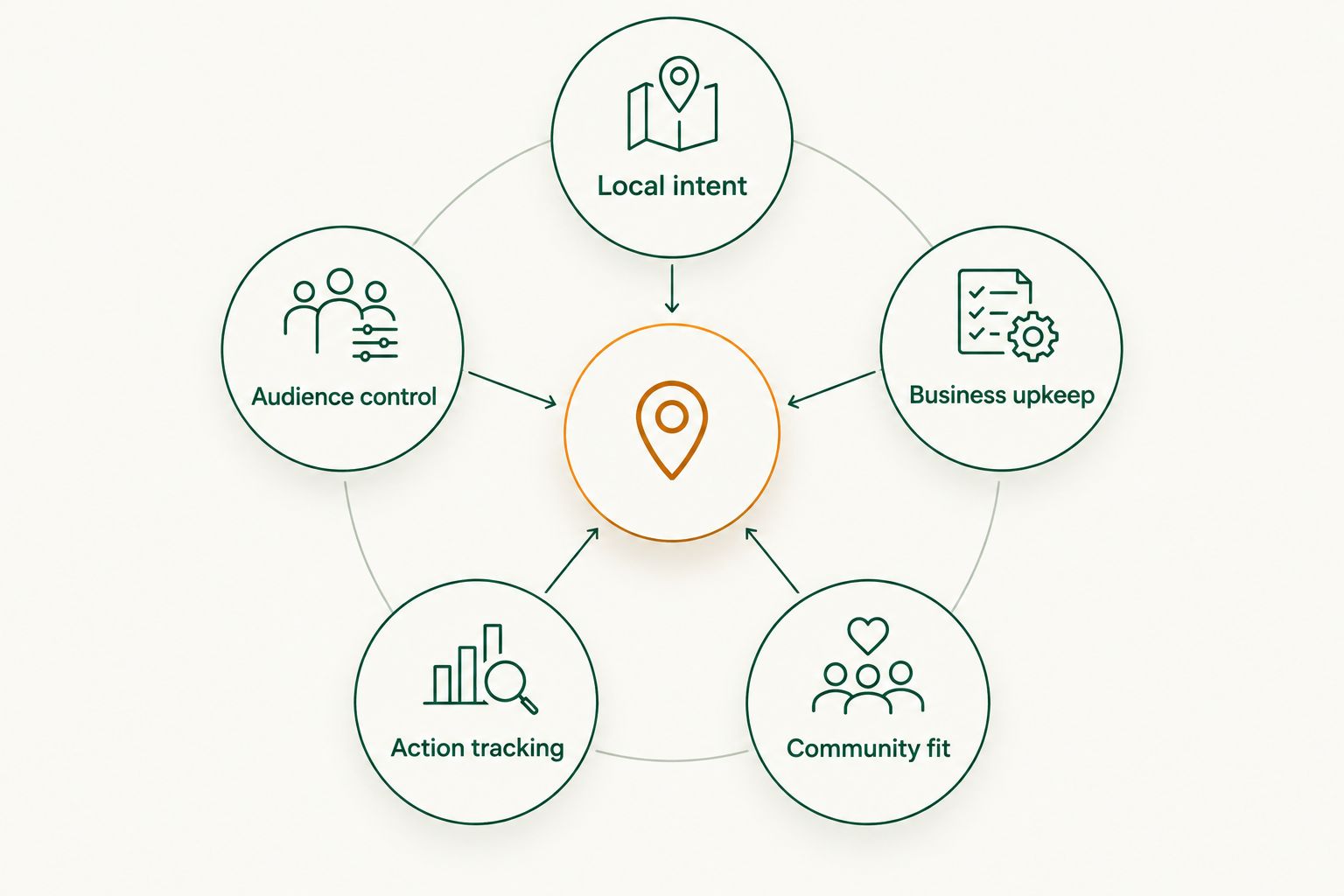
Use these criteria before comparing names. A strong choice for one shop can be a poor fit for the business next door.
- Local intent: Does the platform reach people looking for a business nearby, or people browsing without a specific need?
- Audience control: Can you choose who sees a paid message, or does discovery depend on how people use the platform?
- Business upkeep: What must you maintain: listing details, specials, photos, replies, or ad campaigns?
- Action tracking: Can you identify the customer action that matters, such as a call, inquiry, visit, or stated referral source?
- Community fit: Does the platform suit a business that wants ongoing neighborhood discovery rather than a single campaign?
Do not treat audience size as a substitute for fit. A local restaurant sharing a special and a contractor seeking urgent service inquiries need different routes to a customer. For a 2026 decision, write down the action you want before choosing the platform. That one step makes the comparison more useful than a list of features.
The diagram separates customer discovery from the work and measurement needed to support it. Use all five criteria rather than choosing on visibility alone.
At a glance: the best options in 2026
| Platform | Best for | Standout feature | Key limitation |
|---|---|---|---|
| Google Business Profile | Local search foundation | Business information in Google Search and Maps | A profile alone is not a paid ad campaign |
| HometownFirst | Community discovery | Directory profiles with specials and events | Needs an owner to keep information current |
| Google Ads | Search-ad visibility | Ads tied to relevant searches | Campaign setup and review demand attention |
| Meta Ads | Visual local promotions | Ads across Facebook and Instagram | Browsers are not necessarily looking for you |
| Nextdoor | Neighborhood presence | Local conversations and discovery | Fit depends on how your neighbors use it |
The default for most owners is Google Business Profile first. It addresses local search intent. Add a different platform when you have a distinct job for it: a community directory presence, search advertising, visual promotion, or neighborhood participation. That is a more useful 2026 plan than opening accounts everywhere and letting them sit.
1. Google Business Profile: best for local search basics
Google Business Profile lets a business manage information that appears across Google Search and Maps. When someone searches for a nearby business or a specific shop, accurate details give them a clearer route to the next step. It is the strongest starting point on this list because it addresses a basic discovery task before you add another channel.
A profile is not a complete marketing plan. It depends on accurate business information and continued attention, and it does not replace a separate campaign when you want to place search ads. Treat it as your foundation, not proof that every nearby customer has seen you.
Google Business Profile pros:
- Matches the way customers look up businesses in a place.
- Keeps essential business information together in Search and Maps.
- Gives customers a direct route from discovery to contact details.
Google Business Profile cons:
- Does not give you the same campaign controls as Google Ads.
- Needs updates when business details change.
- Does not create a separate community directory presence.
Best for: A business that wants people searching nearby to find dependable business details.
Before adding another platform in 2026, check that the information customers use to reach you is accurate. If you operate more than one location, review each location separately; one correct profile does not fix an outdated detail elsewhere. Verdict: Buy into the work of maintaining Google Business Profile first.
2. HometownFirst: best for community discovery
HometownFirst is a local business directory for people who want to discover nearby restaurants, retail shops, and services. Business owners can list profiles, post specials, and share events. That makes HometownFirst a fit when the goal is to be found by neighbors browsing locally, not only by people already searching for your business name.
The distinction matters. A directory presence gives you a place to tell people what is happening at your business, while a search ad is designed around a campaign. Neither replaces the other. If your business has no one to check its details or keep specials current, you will get less from an active directory profile.
HometownFirst pros:
- Focuses on discovery of local businesses.
- Supports profiles, specials, and events in one directory setting.
- Fits independent businesses that want to connect with nearby customers.
HometownFirst cons:
- Requires attention to keep a profile and time-sensitive posts useful.
- Does not replace search ads aimed at a particular query.
- Is less suited to a business that cannot define the local audience it wants to reach.
Best for: An independent local business with a clear reason for neighbors to discover it, return, and check what is new.
For 2026, decide who will maintain the listing before adding specials or events. A restaurant might use the profile to share an upcoming event; a service business might focus on making its offering clear. Verdict: Buy into HometownFirst when community discovery is the job.
3. Google Ads: best for search-ad visibility
Google Ads lets businesses place ads associated with searches. It fits a different moment from casual browsing: the person is actively looking for something, and your campaign is designed to appear for relevant searches. That makes it a practical option when you can identify the service or product people look for and the action you want after they find you.
The trade-off is management. You need to choose relevant searches, write useful ads, direct people to a suitable destination, and review whether the resulting contacts match your goal. Paying for visibility without deciding what counts as a worthwhile inquiry makes results hard to judge.
Google Ads pros:
- Connects an ad with an expressed search.
- Supports campaigns built around a defined customer action.
- Fits businesses with a specific offering people already look up.
Google Ads cons:
- Demands campaign setup and ongoing review.
- A click does not establish that someone became a customer.
- Works poorly as a substitute for clear business information.
Best for: A business seeking inquiries from people actively searching for its offering.
In 2026, start with the customer action, not the ad format. Record whether the campaign produced the kind of call or inquiry you wanted, and check that the destination answers the searcher's question. Verdict: Buy into Google Ads when you can manage and assess a search campaign; otherwise, wait.
4. Meta Ads: best for visual local promotions
Meta Ads places advertising across Facebook and Instagram. It suits a business that has something people can understand quickly while browsing: an event, a new arrival, or a clear service introduction. Unlike a search ad, the message can reach someone before they decide to look for that offering.
That difference is both the benefit and the limitation. A person who sees a promotion while browsing is not necessarily ready to visit or inquire. The message has to explain why a nearby customer should care, and you need to check whether interest turns into an action at your business.
Meta Ads pros:
- Fits offerings that benefit from photos or short visual explanations.
- Can introduce an event or promotion to people who were not searching for it.
- Gives you room to test different messages around one customer action.
Meta Ads cons:
- Browsing attention is not the same as active buying intent.
- Creative materials and campaign review take time.
- Likes or views alone do not tell you whether customers came in.
Best for: A local business with a clear visual offer and the capacity to manage an ad campaign.
For a 2026 test, choose one action to watch, such as an inquiry about the event or a customer mentioning the promotion. Do not use engagement alone as your verdict. Verdict: Buy into Meta Ads for a defined visual promotion; otherwise, hold.
5. Nextdoor: best for neighborhood participation
Nextdoor is organized around neighborhoods. For a local business, that makes it relevant to customers who think in terms of where they live and the businesses around them. It is a different setting from a search engine: local context matters, but a neighbor reading a discussion is not necessarily looking to make a purchase.
Choose it for a specific neighborhood purpose, not because another business has an account there. Decide whether you can participate appropriately and keep any business information accurate. If you need immediate responses to a defined search, a search-focused option is the clearer match.
Nextdoor pros:
- Centers the neighborhood context of a local business.
- Fits businesses that want a presence where neighbors connect.
- Offers another route to discovery beyond search results.
Nextdoor cons:
- Neighborhood attention does not guarantee purchase intent.
- Requires a relevant reason to participate rather than repeated promotion.
- Is a weaker fit when your main goal is a search-led inquiry.
Best for: A business that can participate in neighborhood activity with useful, locally relevant information.
Assess it in 2026 by asking customers how they heard about you, rather than assuming every local conversation led to a visit. Verdict: Hold until you have a clear neighborhood role; buy into it when you do.
How these options were ranked
The order puts local search basics first, then separates community discovery from paid campaigns and neighborhood participation. It follows the five criteria above: local intent, audience control, business upkeep, action tracking, and community fit. It does not claim that a directory and an ad campaign deliver the same outcome.
For your own ranking, use a 30-day review window and write down the action you want to see from each platform. Ask customers where they found you, and keep the answers separate by channel. At the end of those 30 days, you can judge whether the channel is producing the kind of contact you wanted instead of comparing unlike metrics.
If you serve 2 locations, make the location part of that review. A platform can fit one area's customers better than another's, and combined reporting can hide which place needs attention. The point is not to collect more numbers. It is to make the next decision with the customer action and location in view.
Which advertising platform should you choose?
Choose Google Business Profile first if your local search information needs work. Choose HometownFirst next when you want a directory presence built around local discovery, specials, and events. Choose Google Ads when you are ready to manage search campaigns; choose Meta Ads for a visual promotion; choose Nextdoor when neighborhood participation has a clear purpose.
You do not need all five. A sensible 2026 setup gives each platform one job and one person responsible for it. If two platforms appear to do the same job, define the difference before taking on both. For example, a directory profile can help someone browsing local businesses learn about you, while a search campaign addresses a person looking up a particular offering. Judge each by the action it is supposed to produce.
FAQ
What's the best advertising platform for a local business in 2026?
Google Business Profile is the best starting point for local search visibility in 2026. Add a directory or ad platform when you have a separate discovery or campaign goal.
Is HometownFirst better than Google Ads for a small business?
HometownFirst is the better fit for community directory discovery; Google Ads is the better fit for a managed search-ad campaign. Choose according to whether you want ongoing local browsing or inquiries tied to searches.
Is Google Business Profile an advertising platform?
Google Business Profile is a business listing, not the same thing as a paid ad campaign. It belongs in this comparison because local owners need accurate search information alongside any advertising they run.
Should a local restaurant use Meta Ads or a business directory?
Use Meta Ads for a defined visual campaign and a business directory for an ongoing place to be discovered. A restaurant can choose either or both if each has a distinct job and someone to maintain it.
What is Nextdoor best for as a local business?
Nextdoor is best for a business with a clear reason to participate in neighborhood activity. It is less direct than a search-focused option when the goal is an inquiry from someone seeking a specific service.
How do I tell whether a local advertising platform works?
Define the action you want, then record calls, inquiries, visits, or customer-reported discovery sources by platform. Review each platform against its own job rather than treating views and inquiries as equivalent.
Do I need to use every local advertising platform?
No. Start with accurate local search information, then add a platform only when it serves a different customer need and you can maintain it.
One last thing
The best platform cannot correct a confusing description of your business. Before you run a 2026 campaign or post a special, read your profile as a neighbor would: can you tell what the business offers, where it serves people, and what to do next? Fix that first. It makes every later platform choice easier to judge.