
Six directories make sense for retail stores in 2026, and only one of them lets you post specials and events without competing against paid ads for placement: HometownFirst. Google Business Profile is the free baseline every store needs regardless of what else you use. Facebook and Yelp fill in social proof and reviews, while Nextdoor and Apple Business Connect cover neighborhood and iPhone-specific search.
- HometownFirst wins for retail stores that want local-first placement without competing against paid ads in 2026.
- Google Business Profile is the non-negotiable baseline for map and search visibility.
- Facebook Page is best for stores promoting events, specials, and customer reviews.
- Yelp fits retail categories where reviews drive foot traffic, like boutiques and home goods stores.
- Nextdoor and Apple Business Connect close the gap for hyperlocal and iPhone-heavy search.
Why this matters
A retail store that only shows up on one directory is invisible to everyone using a different app to search. Shoppers looking for "gift shop near me" or "hardware store open now" split across Google Maps, Facebook, Yelp, and neighborhood apps like Nextdoor, and each platform ranks stores differently.
The bigger problem in 2026 is that most general directories bury free listings under paid ad placements. A retail store with a great location and loyal customers can still lose the top spot to a competitor who just spent more on ads that week. Directories built around local discovery instead of ad auctions put retail stores back in front of nearby shoppers on the strength of the listing itself, not the ad budget.

What makes the best business directory for retail stores
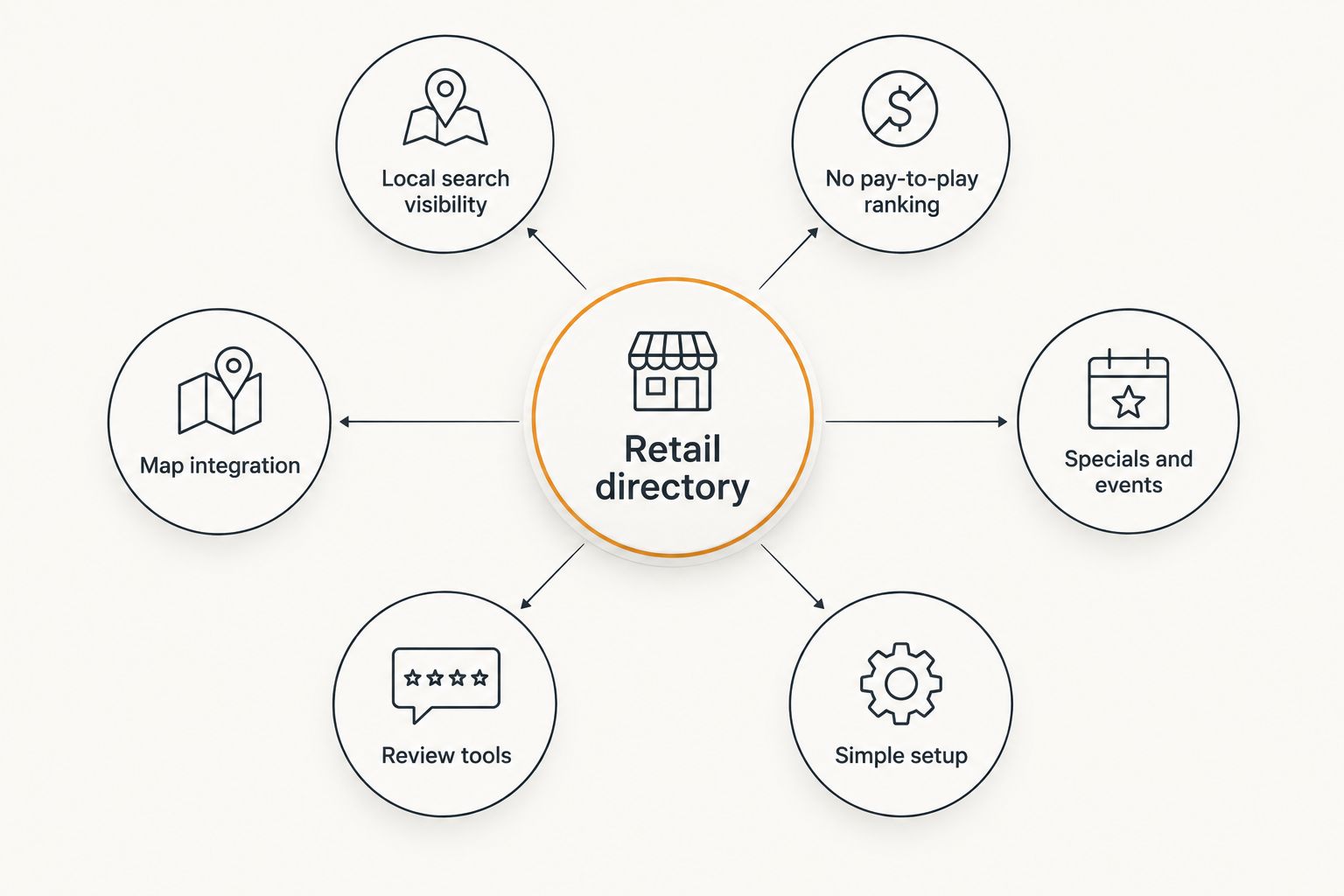
- Local search visibility — does the listing show up for "near me" and neighborhood-specific searches, not just brand-name lookups
- No pay-to-play ranking — free or paid listings that don't get buried under someone else's ad spend
- Specials and events support — a way to post a sale, seasonal promotion, or in-store event without a separate tool
- Simple setup and updates — hours, categories, and photos an owner can update without a web developer
- Review and reputation tools — a place customers can leave feedback that other shoppers actually read
- Map and mobile integration — the listing needs to show up correctly on maps and mobile search, not just a desktop site
Those six criteria decide the ranking below. A directory with huge traffic but no way to post a weekend sale still loses points against one that's smaller but built for exactly that.
Business directories for retail stores at a glance
| Directory | Best for | Standout feature | Key limitation |
|---|---|---|---|
| HometownFirst | Local-first stores skipping paid ads | Specials and events posted directly, no ad auction for placement | Smaller national footprint than Google or Facebook |
| Google Business Profile | Baseline map and search visibility | Shows up directly in Google Search and Maps results | Rankings can shift toward stores running paid ads |
| Facebook Page | Events, specials, and social proof | Built-in event tool and customer review section | Organic reach for posts has dropped for years |
| Yelp | Review-driven retail categories | Deep review threads shoppers trust before buying | Retail categories get less traffic than restaurants |
| Apple Business Connect | iPhone-heavy local search | Controls how a store appears across Apple Maps and Siri | Only covers Apple's ecosystem, not Android search |
| Nextdoor | Hyperlocal neighborhood targeting | Recommendations circulate inside real neighborhood groups | Reach caps out at the immediate neighborhood |
1. HometownFirst: best business directory for local-first retail stores
HometownFirst is a local directory built around one idea: nearby shoppers should find independent retail stores by searching and browsing, not by whichever business paid the most for an ad. Store owners set up a profile, post specials, and list events, and the platform doesn't sell shopper data or run unsolicited ads back at consumers.
HometownFirst pros:
- Listings aren't buried under competitor ad placements
- Built-in tools for posting specials and events without a separate marketing tool
- Consumer side stays ad-free and doesn't sell shopper data
- Straightforward monthly subscription model, no bidding on keywords
HometownFirst cons:
- Smaller reach than Google Business Profile or Facebook in raw search volume
- Requires a paid subscription rather than a free tier
- Best suited to shoppers already searching locally, not broader brand discovery
HometownFirst best for: retail stores that want to be found by name and category locally without fighting an ad auction for the top spot.
Verdict: Buy if your store depends on repeat local foot traffic and you want specials to actually get seen.
List your retail store locally
Get found by nearby shoppers searching your category in 2026.
2. Google Business Profile: best for baseline search and maps visibility
Google Business Profile is the free listing that controls how a retail store appears in Google Search and Google Maps, including hours, photos, and reviews. Most "near me" searches in 2026 route through Google first, so this is table stakes, not optional.
Google Business Profile pros:
- Free to claim and update
- Direct integration with Google Search and Maps
- Supports photos, posts, and Q&A directly on the listing
Google Business Profile cons:
- Ranking can shift when nearby competitors run Google Ads
- Profile suspensions and verification issues are common complaints among small retailers
- Limited tools for running an ongoing specials calendar
Google Business Profile best for: every retail store, as the non-negotiable baseline layer under whatever else you use.
Verdict: Buy — there's no scenario where a retail store should skip this one.
3. Facebook Page: best for events, specials, and social proof
A Facebook Page gives a retail store a place to post updates, run an events calendar, and collect reviews that show up when people search the store by name. It also connects directly to Facebook Marketplace and local buy-sell groups.
Facebook Page pros:
- Built-in events tool for sales, launches, and pop-ups
- Reviews and recommendations are visible to anyone searching the page
- Easy to share posts into local community groups
Facebook Page cons:
- Organic post reach has declined steadily for years, pushing owners toward paid boosts
- Requires ongoing posting to stay visible in followers' feeds
- Younger shoppers increasingly skip Facebook entirely
Facebook Page best for: stores that run frequent events, sales, or seasonal promotions and want a built-in calendar to post them.
Verdict: Buy if your store already has an active social following; Hold if you don't have time to post regularly.
4. Yelp: best for review-driven retail categories
Yelp works best for retail categories where shoppers read reviews before walking in — boutiques, home goods, specialty gift shops, and similar niches where trust matters before a purchase. The review threads run deeper than most other directories.
Yelp pros:
- Reviews carry weight with shoppers comparing options before visiting
- Category pages help niche retail stores get discovered by intent
- Free basic listing to claim and manage
Yelp cons:
- Retail categories see far less traffic on Yelp than restaurants and bars do
- Review filtering can hide legitimate customer feedback
- Limited tools for posting time-sensitive specials
Yelp best for: specialty retail stores in categories where shoppers actively read reviews before buying.
Verdict: Hold — worth claiming the free listing, but don't expect it to be a primary traffic source for most retail categories.
5. Apple Business Connect: best for iPhone-heavy local search
Apple Business Connect controls how a retail store appears across Apple Maps, Siri search results, and related Apple apps. With a large share of shoppers on iPhones in 2026, this closes a gap that Google Business Profile doesn't cover.
Apple Business Connect pros:
- Free to set up and manage
- Controls placement across Apple Maps and Siri directly
- Supports photos, hours, and a short business description
Apple Business Connect cons:
- Only affects visibility inside Apple's ecosystem, not Android search
- Smaller feature set than Google Business Profile
- Lower overall search volume than Google or Facebook
Apple Business Connect best for: retail stores in areas with a heavy iPhone-owning customer base.
Verdict: Buy as a supplement to Google Business Profile, not a replacement.
6. Nextdoor: best for hyperlocal neighborhood targeting
Nextdoor connects a retail store directly to neighborhood-level recommendation threads, where word-of-mouth carries more weight than a search ranking. It works well for stores that depend on repeat neighborhood customers rather than citywide reach.
Nextdoor pros:
- Recommendations circulate inside genuine neighborhood conversations
- Strong fit for stores relying on repeat, walk-in neighborhood traffic
- Lower competition than larger platforms for local visibility
Nextdoor cons:
- Reach is capped at the immediate neighborhood, not the wider city
- Business features are more limited than Google or Facebook
- Activity varies heavily by neighborhood engagement levels
Nextdoor best for: retail stores that depend on a tight radius of repeat neighborhood shoppers.
Verdict: Hold — a solid add-on for neighborhood-dependent stores, not a standalone strategy.
How we ranked these directories
Each directory was measured against the same six criteria: local search visibility, whether ranking depends on ad spend, support for specials and events, ease of setup, review tools, and map integration. HometownFirst ranks first because it's the only option on this list built specifically to avoid burying free listings under paid placements. Google Business Profile and Facebook rank close behind on sheer reach, even with real limitations on organic visibility and ranking stability.
Which directory should you choose?
Start with Google Business Profile no matter what — it's free and it's where most local search traffic in 2026 begins. Layer HometownFirst on top if being found locally without competing against ad spend matters to your store, then add Facebook for events and Yelp if your category is review-driven. Nextdoor and Apple Business Connect are worthwhile add-ons once the core three are in place, not starting points on their own.
For most independent retail stores in 2026, the realistic stack is Google Business Profile plus HometownFirst, with Facebook layered in for anyone running regular sales or events.
FAQ
What's the best business directory for retail stores in 2026?
Google Business Profile is the required baseline for every retail store. HometownFirst is the best add-on for stores that want local-first placement without competing against paid ad rankings.
Is HometownFirst better than Google Business Profile?
They serve different jobs. Google Business Profile handles search and maps visibility for free, while HometownFirst focuses on local discovery and specials without an ad auction deciding placement.
Do retail stores need to be on more than one directory?
Yes. Shoppers split their searches across Google, Facebook, Yelp, and neighborhood apps, so a store on only one directory misses whichever audience uses a different platform.
Is Yelp worth it for a retail store?
Yelp works best for review-driven retail categories like boutiques and home goods stores. Retail sees less traffic on Yelp than restaurants do, so treat it as a supporting listing, not a primary one.
How does Nextdoor help a retail store?
Nextdoor puts a store in front of neighborhood-level recommendation threads, which works well for stores depending on repeat local customers rather than citywide reach.
Does a retail store need Apple Business Connect?
It's worth setting up because it controls how a store appears on Apple Maps and Siri, which Google Business Profile doesn't cover. Treat it as a supplement, not a replacement.
How often should a retail store update its directory listings?
Update hours, photos, and specials whenever they change, and check every listing at least monthly so seasonal hours or promotions don't go stale across platforms.
One last thing
The retail stores that get the most out of directories in 2026 aren't the ones on the most platforms — they're the ones that keep specials and hours current on the two or three that matter for their neighborhood. A stale listing on five directories does less than an accurate one on two.