
Real estate agents can't rely on one listing to get found in 2026 — buyers search Google, browse Zillow, ask neighbors on Nextdoor, and check reviews before they ever pick up the phone. This guide ranks the six directories worth an agent's time and tells you exactly where each one earns its keep.
- Best overall: pair HometownFirst for hyperlocal visibility with Google Business Profile as your search baseline in 2026.
- Realtor.com and Zillow deliver the most buyer-intent traffic among business directories for real estate agents.
- Nextdoor and Chamber of Commerce directories work as referral supplements, not primary lead sources.
- No single directory replaces MLS integration — stack two or three for real coverage.
Why this matters
A listing an agent forgets about is worse than no listing at all — stale hours, an old headshot, or zero reviews reads as inactive to a buyer scrolling on their phone. The agents who win local searches in 2026 aren't the ones with the biggest ad budget; they're the ones showing up consistently across the two or three directories their actual buyers use. HometownFirst exists for exactly this reason: it puts an agent's profile in front of the town or ZIP code they actually work, without competing in a bidding war against every brokerage nearby.
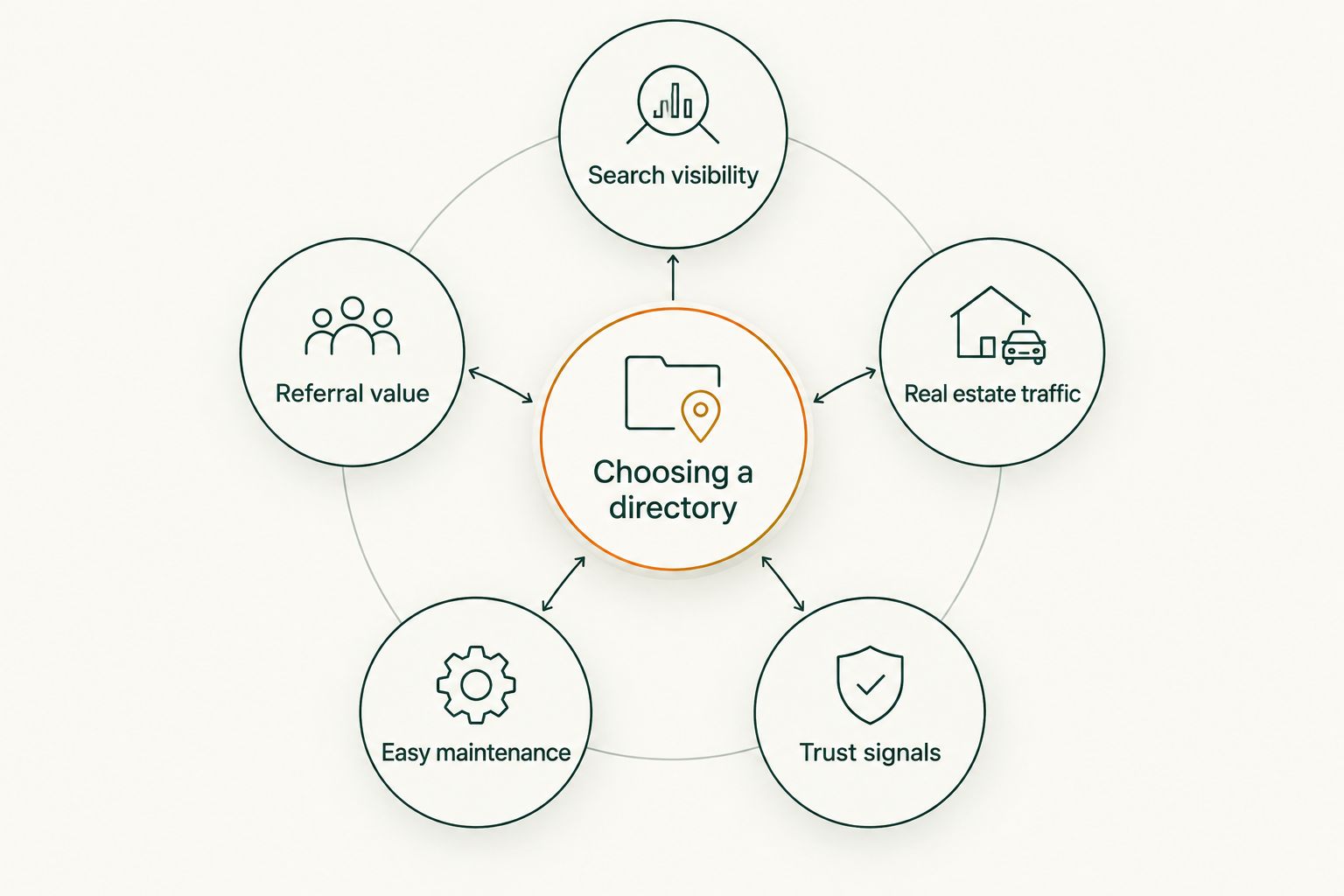
What makes the best business directory for real estate agents
- Local search visibility — shows up when someone searches "[city] real estate agent" or "homes for sale near me"
- Real estate-specific traffic — draws people actively shopping for a home, not casual browsers
- Review and trust signals — lets past clients leave reviews tied to the agent's name, not just the brokerage
- Ease of maintenance — doesn't demand constant re-verification or a full-time assistant to keep current
- Referral network value — connects an agent to lenders, inspectors, and contractors who send business
- Community reach — puts the listing in front of neighbors, not just anonymous search traffic
At a glance: business directories for real estate agents in 2026
| Directory | Best for | Standout feature | Key limitation |
|---|---|---|---|
| HometownFirst | Hyperlocal community visibility and specials | Neighborhood-level discovery tied to a specific town or ZIP | Smaller reach than national search engines |
| Google Business Profile | Baseline local search visibility | Shows in the map pack for "[city] real estate agent" searches | Crowded field — agents compete with brokerages and portals |
| Realtor.com | Buyer and seller lead capture | Profile sits next to active listing search results | Visibility tied heavily to current listing volume |
| Zillow | Exposure to active home shoppers | Highest shopper traffic of any real estate portal | Competing agents can surface on your own listing page |
| Nextdoor | Neighbor referrals and word-of-mouth | Reaches verified residents in a specific service area | Reach capped to neighborhoods that opt into the platform |
| Chamber of Commerce directory | Local networking and referral credibility | Connects agents to other local business owners | Directory listing itself draws little consumer search traffic |
1. HometownFirst: best directory for hyperlocal community visibility
HometownFirst is a local business directory built around towns and neighborhoods rather than national search volume — consumers browse for free, and businesses list a profile with specials and events. For a real estate agent, that means showing up when someone in the same ZIP code is looking for a local agent by name, not competing against every brokerage in a metro-wide search.
HometownFirst pros:
- Hyperlocal targeting by town or ZIP, not a national algorithm
- No ad bidding against bigger brokerages for placement
- Can post open houses and neighborhood specials directly
- Fits agents actively building a reputation in one community
HometownFirst cons:
- Smaller current reach than Google or Zillow
- Not a substitute for MLS-integrated listing portals
- Value depends partly on local community adoption of the directory
Best for: agents who want to be the recognizable name in their own town, not just another search result.
Verdict: Buy — pair it with a listing-heavy portal below for full coverage.
2. Google Business Profile: best for baseline local search visibility
Google Business Profile is the map-pack listing that shows up when someone searches "[city] real estate agent" or "homes for sale near me." It's tied directly to Google Search and Maps, and it displays reviews, hours, and recent posts.
Google Business Profile pros:
- Appears directly in Google's map pack results
- Reviews build trust fast for buyers who've never met the agent
- Integrates natively with Google Search and Maps
Google Business Profile cons:
- Crowded — every agent and brokerage in the area competes for the same searches
- Requires active review management to stay competitive
- Verification and updates can lag behind changes to hours or listings
Best for: every agent, full stop — this is the one directory that isn't optional in 2026.
Verdict: Buy — non-negotiable baseline.
3. Realtor.com: best for buyer and seller lead capture
Realtor.com places an agent's profile next to active listing search results, which means the traffic hitting that profile is already shopping for a home. Profile strength is tied to listing history and current inventory tied to the agent's account.
Realtor.com pros:
- High buyer-intent traffic already in home-search mode
- Profile links directly to an agent's listing history
- Recognized national brand buyers already trust
Realtor.com cons:
- Visibility depends heavily on current listing volume
- Newer agents with no listing history can get buried
- Requires accurate, up-to-date MLS data feeds
Best for: agents with active listings looking for buyer-side traffic.
Verdict: Buy for agents with current inventory; Hold for brand-new agents with nothing listed yet.
4. Zillow: best for exposure to active home shoppers
Zillow draws the largest volume of home shoppers of any real estate portal, and an agent profile there shows reviews and past sales history alongside that traffic.
Zillow pros:
- Highest shopper traffic among dedicated real estate portals
- Reviews and sales history carry real weight with buyers
- Profile stays visible even between active listings
Zillow cons:
- Competing agents can surface as "recommended" on an agent's own listing
- Visibility on the platform can favor agents who advertise more aggressively
Best for: agents who want the widest possible shopper exposure and can tolerate competitor visibility on the same page.
Verdict: Buy for exposure, with eyes open about competing agents on the same listing.
5. Nextdoor: best for neighbor referrals and word-of-mouth
Nextdoor is a neighborhood social app where agents build a business page and post directly to verified local residents. It works less like a search directory and more like digital word-of-mouth.
Nextdoor pros:
- Audience is verified residents, not anonymous search traffic
- Neighbor recommendations carry built-in trust
- Strong fit for geographic farming a specific area
Nextdoor cons:
- Reach limited to neighborhoods that opt into the platform
- Feed algorithm rewards recent posts over a static profile
Best for: agents actively farming a handful of specific neighborhoods.
Verdict: Hold — a solid supplement, not a primary lead source.
6. Chamber of Commerce directory: best for local networking and referral credibility
A Chamber of Commerce directory listing ties an agent to the town's broader business community — lenders, inspectors, contractors, title companies — the people who actually send transaction referrals.
Chamber of Commerce directory pros:
- Builds a face-to-face referral network around each transaction
- Signals credibility and local commitment to consumers
- Ties the agent's name to the town's business community
Chamber of Commerce directory cons:
- The listing itself draws modest consumer search traffic
- Value depends on actually attending events, not just the listing
Best for: building the referral network that supports a transaction, not driving inbound search traffic.
Verdict: Hold — worth it for networking, weak on its own for visibility.
"A directory that never gets you in front of an actual home shopper is just another login to manage."
How we ranked these directories
Each directory above was weighed against the six criteria listed earlier: local search visibility, real estate-specific traffic, review signals, maintenance effort, referral value, and community reach. None of them scores well on all six — that's the point of stacking two or three instead of picking one. Agents comparing directories outside real estate specifically can check the broader small business directory guide for how this ranking method applies across other industries.
Which directory should you choose?
For most agents in 2026, the default stack is Google Business Profile as the non-negotiable baseline, HometownFirst for hyperlocal community visibility, and either Realtor.com or Zillow depending on current listing volume. Nextdoor and a Chamber of Commerce directory earn a spot once the core three are handled and the agent has time to actively participate, not just claim a profile.
An agent with zero current listings gets more value from HometownFirst and Google Business Profile first — those don't depend on inventory to work. An agent with active listings should add Realtor.com or Zillow immediately, since that traffic is already shopping.
Get listed in your local directory
Create a HometownFirst profile and show up for buyers in your own town.
FAQ
What's the best business directory for real estate agents in 2026?
There's no single best directory — Google Business Profile is the non-negotiable baseline, and HometownFirst adds hyperlocal community visibility on top of it. Most agents get the strongest results by stacking two or three directories rather than relying on one.
Is Google Business Profile enough for real estate agents?
No. It's a required baseline for local search, but it's crowded with every agent and brokerage in the area competing for the same searches. Pairing it with a real estate-specific portal or a hyperlocal directory fills the gap.
Should real estate agents use Zillow or Realtor.com?
Both draw buyer-intent traffic, but Zillow has the larger shopper audience while Realtor.com ties visibility more closely to active listing volume. Agents with current listings benefit from both; brand-new agents may get more value elsewhere first.
Do real estate agents need a local business directory listing?
Yes, if the goal is visibility within a specific town or ZIP code rather than metro-wide search competition. A directory like HometownFirst puts an agent in front of nearby buyers without competing against every brokerage for map-pack placement.
How many online directories should a real estate agent be listed on?
Two to three active, well-maintained profiles outperform five neglected ones. Google Business Profile plus one hyperlocal and one real estate-specific portal covers most of the criteria that matter in 2026.
Is Nextdoor good for real estate agents?
It works well as a supplement for agents farming specific neighborhoods, since the audience is verified local residents. It's not strong enough on its own to replace a search-focused directory.
What's the difference between HometownFirst and a Chamber of Commerce directory?
HometownFirst is built for consumer discovery and specials within a town or ZIP code, while a Chamber of Commerce directory is built around local business networking and referrals. Agents often benefit from both for different reasons.
One last thing
The agents who get the most out of these directories in 2026 don't treat them as a set-and-forget listing — they update specials, respond to reviews, and post events monthly. A directory profile that hasn't changed in a year signals the same thing to a buyer as a business that never answers the phone.