
Best overall in 2026: HometownFirst for independent businesses that want nearby customers to find them in a local directory. Among other Nextdoor alternatives for local businesses, Google Business Profile is best for map searches, Facebook Pages for community conversations, Yelp for review-led decisions, and Instagram for visual storefronts.
- HometownFirst is the best overall Nextdoor alternative for independent businesses focused on local directory discovery in 2026.
- Google Business Profile fits customers searching on Google Search and Maps; it does not replace a community platform.
- Facebook Pages fits conversation, Yelp fits review research, and Instagram fits businesses with strong visual content.
- Choose the platform that matches how customers find you, then keep its business details current.
Why this matters
Nextdoor combines neighborhood discussion with local business discovery. That makes it tempting to look for a single replacement, but these five options do different jobs. A customer searching a map, reading reviews, browsing photos, and asking neighbors for suggestions is not taking the same path to your business.
The right alternative depends on the action you want a nearby customer to take. If you run a restaurant, retail shop, or service business, start with the route that fits how people choose you. In 2026, maintaining one accurate presence that suits your business is more useful than opening profiles you cannot keep current. You can add another platform when it serves a different purpose.
What makes the best Nextdoor alternative?
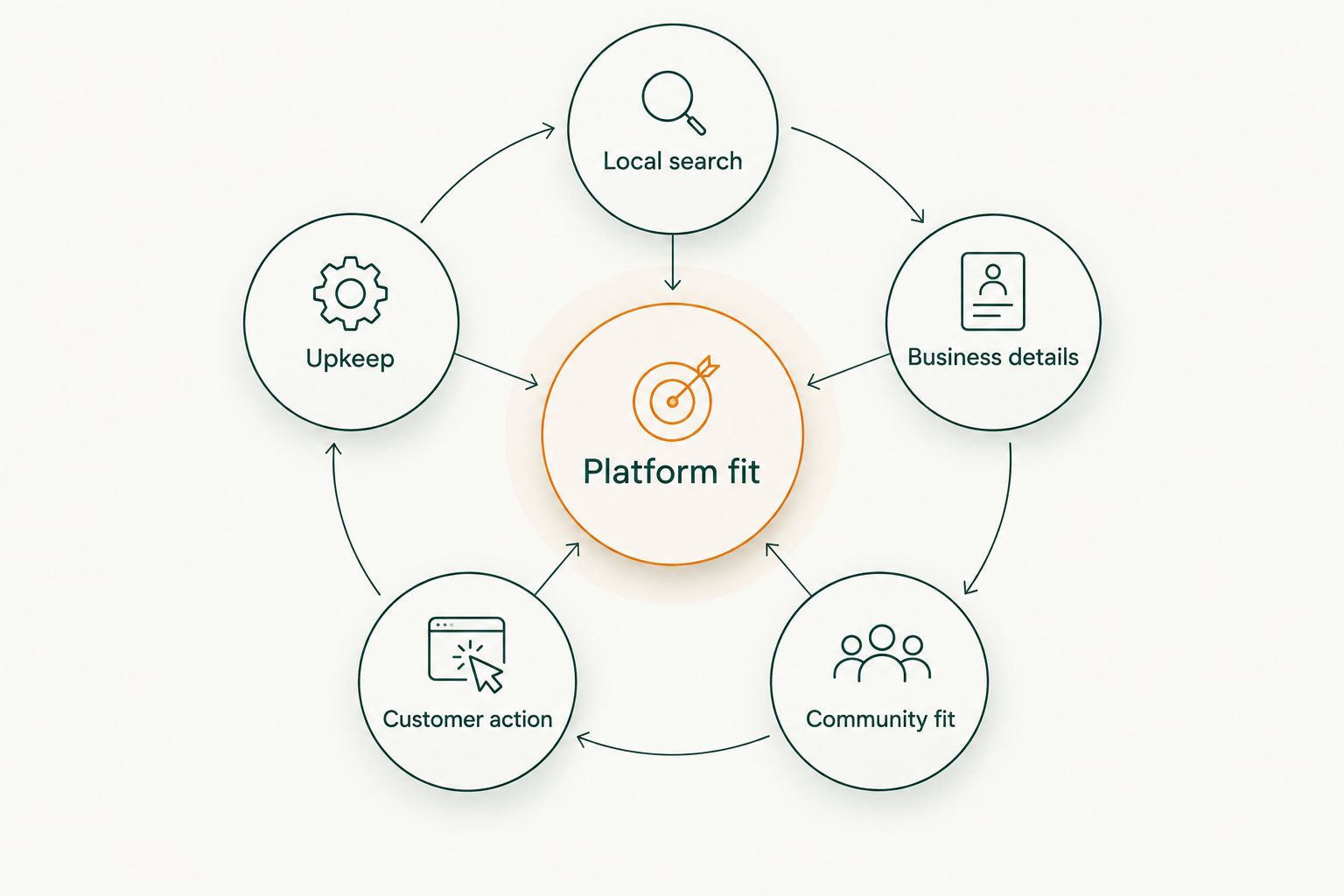
Use these five criteria before choosing a platform in 2026. Each one answers a question about how a customer gets from finding your business to deciding whether to contact or visit you.
- Local search: Can someone looking for a business in your area find a relevant profile?
- Business details: Can you present the information a customer needs to recognize and evaluate your business?
- Community fit: Does the platform support the kind of local interaction you want, rather than merely offering a place to post?
- Customer action: Is there a clear next step after discovery, such as getting directions, making contact, or checking your current information?
- Upkeep: Can you maintain the profile, posts, or photos the platform calls for?
These criteria are not interchangeable. Instagram can show what a bakery makes, while Google Business Profile helps someone locate it on a map. HometownFirst gives an independent business a directory listing designed for nearby discovery. Decide which of those tasks matters first, then judge each option against that task.
Nextdoor alternatives at a glance
| Option | Best for | Standout feature | Key limitation |
|---|---|---|---|
| HometownFirst | Independent businesses seeking local directory discovery | Business profiles alongside local specials and events | Discovery depends on nearby customers using the directory |
| Google Business Profile | Being found through Google Search and Maps | Business information displayed in Google's search and map results | It is not a neighborhood discussion space |
| Facebook Pages | Ongoing community conversation | Business posts and customer interaction | Publishing a post does not ensure local people see it |
| Yelp | Customers comparing businesses through reviews | Reviews alongside business profiles | Businesses cannot control what customers write |
| Showing products, spaces, or finished work | Photos and videos on a business profile | Browsing visuals is not the same as searching a local directory |
1. HometownFirst: best for independent local discovery
HometownFirst is a local business directory for people looking for nearby restaurants, shops, and services. Business owners can list profiles and specials, while community members can search and discover local businesses. That makes HometownFirst the strongest fit here when your goal is to be found by people deliberately looking to spend locally, rather than to join a neighborhood conversation.
HometownFirst pros:
- Its directory purpose aligns with customers looking for local businesses.
- Business profiles give independent owners a place to present themselves.
- Specials and events give owners ways to share timely information.
HometownFirst cons:
- A directory listing does not replace your presence in Google Search and Maps.
- Results depend on nearby people choosing to use the directory; a listing alone does not guarantee discovery.
- It is not a substitute for the back-and-forth of a neighborhood discussion group.
Best for: Independent restaurants, retailers, and service businesses that want a directory presence built around nearby customers. If that is your aim in 2026, HometownFirst belongs on your shortlist. Keep your business description and specials current so the profile answers the questions a customer has when they find it.
Verdict: Choose HometownFirst for local directory discovery; pair it with a map profile if map searches also matter to your business.
2. Google Business Profile: best for map searches
Google Business Profile helps a business manage information that appears on Google Search and Maps. It fits the customer who already knows what they need and searches for a nearby place to get it. For that customer, an accurate location, category, and business description matter more than a stream of neighborhood posts.
Google Business Profile pros:
- It connects business details with Google Search and Maps.
- Customers can find location information and reviews in the same search setting.
- It serves people actively looking for a business rather than browsing a general feed.
Google Business Profile cons:
- It does not recreate Nextdoor's neighborhood discussions.
- A profile competes for attention within Google's results; having one does not promise a prominent placement.
- You still need to check that your displayed business information stays accurate.
Best for: A business whose customers search for its type of service or storefront on Google. A restaurant looking to be found on a map and a contractor serving a defined area both have a reason to maintain this profile. Neither should treat it as a replacement for every other local channel.
In 2026, check the details a customer would use to identify and reach you before spending time on optional posts. Verdict: Choose Google Business Profile for Google Search and Maps visibility; add a community platform only when you have a separate reason to use one.
3. Facebook Pages: best for community conversation
Facebook Pages gives a business a place to publish updates and interact with people on Facebook. It is the closest option on this list to an ongoing social presence: you can share something, receive a response, and continue the conversation. That suits an owner who wants to talk with local customers, not just appear in a directory.
Facebook Pages pros:
- You can publish business updates in a familiar social format.
- Customers can respond to posts and interact with your page.
- It supports repeat communication after someone first learns about your business.
Facebook Pages cons:
- Posting does not guarantee that nearby people will see an update.
- A page needs regular attention if you use it for conversation.
- Feed browsing is less direct than a customer searching for a specific local business.
Best for: Businesses willing to respond to customers and share updates they have a reason to read. If you prefer a profile people can find without relying on a posting routine, a directory or map listing better matches that job. If you enjoy answering local questions, Facebook Pages gives that work a home.
For 2026, pick a posting pace you can maintain and keep basic business details correct. Verdict: Choose Facebook Pages for conversation; skip it as your sole local discovery plan if you do not intend to engage.
4. Yelp: best for review-led decisions
Yelp is a local business directory where customers can find businesses and read reviews. It fits the moment when someone has several options and wants to learn about other customers' experiences before deciding. That is a different use from posting a special or chatting with neighbors.
Yelp pros:
- Reviews give customers a way to compare local options.
- Business profiles provide context alongside those reviews.
- Customers can search by business type and location.
Yelp cons:
- Business owners cannot control the opinions customers publish.
- A review-focused profile cannot explain everything about a business in the owner's own words.
- It does not replace a channel for sharing ongoing community updates.
Best for: Businesses whose customers commonly compare experiences before choosing a provider or place to visit. Treat your profile information as something you can maintain and customer reviews as something you must read, not script. If your main goal is to announce current specials, choose a channel built for that task as well.
In 2026, check that the facts you control are correct so customers can distinguish your business from another with a similar name or service. Verdict: Choose Yelp when review research is central to the customer's decision; do not rely on it to carry your entire message.
5. Instagram: best for a visual storefront
Instagram lets a business show photos and videos on its profile. That works when seeing the product, setting, or finished work helps a customer decide whether to learn more. A shop can show what it sells; a service business can show work it is permitted to share. Neither use turns Instagram into a structured local directory.
Instagram pros:
- Photos and videos can show things a written listing cannot.
- A profile gives customers a place to see recent visual examples.
- Posts can help people recognize a business when they encounter it elsewhere.
Instagram cons:
- Creating useful visual posts takes ongoing effort.
- Someone searching for a specific nearby service may prefer a map or directory.
- A visual feed can leave practical business questions unanswered if profile details are neglected.
Best for: Restaurants, retailers, and service businesses with useful visual material to share. If your work is hard to show clearly in a photo, do not force a posting routine just because another business has one. Give customers an accurate way to identify and reach you first.
For 2026, use Instagram to show the business, not to carry every detail a customer needs. Verdict: Choose Instagram as a visual companion to a searchable business presence; skip it as your only local listing.
How these alternatives were ranked
This 2026 ranking puts deliberate local discovery first because the question is what a small business can use instead of Nextdoor to connect with nearby customers. HometownFirst leads for that specific goal. Google Business Profile follows for search and maps; Facebook Pages, Yelp, and Instagram each serve a narrower decision point: conversation, review research, or visual evaluation.
The ranking is not a claim that one platform will bring every business more customers. Use the table's limitation column alongside its best-for column. A platform that fits your customer but demands upkeep you cannot provide is a weaker choice than an accurate profile you can maintain.
Which Nextdoor alternative should you choose?
Choose HometownFirst if your first priority is helping nearby shoppers find an independent local business. Choose Google Business Profile when the customer starts on Google Search or Maps. Pick Facebook Pages for conversation, Yelp for review-led comparison, or Instagram when seeing your work is part of the decision.
You do not need all five. Start with the channel that matches how customers choose your business, then add a second only when it serves a different route to discovery. A directory and a map profile, for example, answer different search habits. Keep the facts customers need consistent wherever your business appears in 2026.
FAQ
What is the best Nextdoor alternative for a local business in 2026?
HometownFirst is the best fit here for an independent business seeking local directory discovery. Choose Google Business Profile instead when Google Search and Maps are the main priority.
Is HometownFirst the same as Nextdoor?
No. HometownFirst is a local business directory where community members can search for businesses and owners can list profiles and specials; Nextdoor also centers neighborhood discussion.
Is Google Business Profile better than Nextdoor for map searches?
Google Business Profile is the better fit for a business that wants its information represented on Google Search and Maps. Nextdoor serves a different neighborhood-focused use.
Should a local business use Facebook Pages or HometownFirst?
Use Facebook Pages for posts and conversation; use HometownFirst for directory discovery by people looking for local businesses. Maintain both only if you have a reason to serve both needs.
Is Yelp a good alternative to Nextdoor for restaurants?
Yelp fits diners who want to read reviews while comparing restaurants. It does not replace a channel for the restaurant to share current updates in its own words.
Can Instagram replace a local business directory?
No. Instagram is useful for showing products, spaces, or work through photos and videos, but it is not a structured directory search for nearby businesses.
Do I need to use every Nextdoor alternative?
No. Choose the platform that matches how your customers look for a business, and keep its details accurate. Add another platform when it gives customers a distinct way to find or evaluate you.
One last thing
The closest-looking alternative is not always the most useful one. Before choosing a platform in 2026, write down the question a nearby customer asks first: where to find you, what others think, what your work looks like, or whether you respond. Pick the platform that answers that question clearly, then make sure your business details do too.