
Best overall: Facebook. Best for visual discovery: Instagram. Best for neighborhood conversations: Nextdoor. Among social media platforms to promote a local business in 2026, your best choice depends on how customers find you and what you can keep posting. HometownFirst is a local business directory, not a social platform; use it alongside social posts so nearby customers have another way to discover your business and specials.
- Facebook is the best overall social media platform to promote a local business with updates, events, and community conversations.
- Instagram is best for shops, restaurants, and services you can show clearly in photos or video.
- Nextdoor is best for joining neighborhood conversations; read community rules before promoting your business.
- HometownFirst adds local directory discovery alongside social media; it does not replace a posting schedule.
Why this matters
A social account only helps when the right neighbors see it and know what to do next. A restaurant can show tonight’s special. A repair shop can answer the question a homeowner is already asking. Those are different jobs, and they do not need the same platform.
Choose one primary channel before you try to keep five accounts active. In 2026, a useful local presence still comes down to clear business information, relevant posts, and replies when people ask questions. HometownFirst serves a different role: it helps people search for local businesses and lets owners list their profiles, specials, and events. Keep the distinction clear. A directory listing gives people a place to find you; social media gives you a place to join conversations.
What makes the best platform for local promotion?
Use these criteria to choose among social media platforms to promote a local business. The winner is the channel you can use consistently and where your likely customers have a reason to pay attention.
- Local relevance: Can you speak to a neighborhood, community, or nearby customer need without sounding out of place?
- Content fit: Do your products or services make sense as photos, short videos, event updates, or written answers?
- Conversation fit: Can people ask questions, comment, or recommend you in a way your business can respond to?
- Time to maintain: Can you make useful posts and answer messages without letting the account become another neglected task?
- Clear next step: Does your post tell a person how to find the business, ask a question, or learn about a current special?
Do not treat follower counts as the whole scorecard. For a local business, a question about your hours or a request for an appointment is more useful than attention from people who cannot visit. Track the inquiries you receive, and ask new customers how they heard about you.
At a glance: the best social media platforms for local businesses
| Platform | Best for | Standout feature | Key limitation |
|---|---|---|---|
| A general-purpose local presence | Business updates, events, and conversations in one place | Community groups set their own promotion rules | |
| Showing products, food, spaces, or visible work | Photo and video-led posts | A weak fit when there is little to show | |
| Nextdoor | Neighborhood conversations | Locally focused discussion | Repeated sales posts can feel intrusive |
| TikTok | Businesses able to make short videos regularly | Video demonstrations and behind-the-scenes clips | Takes ongoing filming and editing time |
| Local business-to-business relationships | Professional updates and introductions | A weaker fit for everyday consumer discovery |
The table is a starting point, not a reason to open every account. Pick the row that matches what your customers want to see. Then commit to a manageable posting routine before adding another platform.
1. Facebook: best social media platform for a general local presence
Facebook is the default choice when your business needs one place for updates, events, and customer questions. A business page can carry information about what you do while posts keep regulars informed. If you take part in a community group, join the conversation as a neighbor rather than treating the group as an ad board.
A restaurant can post an event or a current special. A service business can answer a common question and explain how customers can get in touch. Neither needs a polished campaign to give a nearby person useful information.
Facebook pros:
- Supports several useful post types, including photos, written updates, and events.
- Gives customers a familiar place to ask questions and share posts.
- Works for businesses that do not have a steady supply of short videos.
Facebook cons:
- An inactive page leaves customers with old information.
- Group rules differ, so a promotional post that fits one community can be removed from another.
- A page alone does not guarantee that nearby people will see each update.
Best for: An independent business that wants one social account to maintain first. Keep your business details current, answer questions, and make each post useful on its own. In 2026, choose consistency over opening more accounts than you can manage.
Verdict: Buy — make Facebook your first channel if you need a flexible local presence.
2. Instagram: best social media platform for visual local businesses
Instagram is a strong match when a customer can understand your offer by seeing it. Think of a retailer showing new items, a restaurant showing a dish, or a service business showing a finished piece of work. Short captions should still say what the viewer is looking at and why it matters locally.
Use the formats you can keep up with. A clear photo with useful context beats a video you never finish making. If customers need details that an image cannot convey, put those details in the caption and answer follow-up questions.
Instagram pros:
- Lets you show products, spaces, and visible work directly.
- Gives you room to explain a special or event alongside the image.
- Makes a repeatable photo habit practical for businesses with something new to show.
Instagram cons:
- Less natural for services whose value is hard to photograph.
- Visual posts still need accurate context; a good-looking image cannot answer every customer question.
- Keeping it active takes a dependable source of photos or video.
Best for: Restaurants, retailers, salons, and other businesses that can show the result of what they do. In 2026, use Instagram to answer the customer’s first visual question, then make the next step clear.
Verdict: Buy — prioritize Instagram when seeing your work helps someone choose you.
3. Nextdoor: best social media platform for neighborhood conversations
Nextdoor centers conversations around local communities. That makes it a sensible place to listen for nearby questions and contribute when your business has a relevant answer. It is not permission to turn every discussion into a sales pitch.
Read the rules that apply to a conversation before posting. If someone asks for help with a problem your business handles, give a useful answer first and identify your connection to the business clearly. A direct, relevant reply serves the neighbor better than a copied promotion.
Nextdoor pros:
- Keeps the conversation tied to neighborhoods rather than a broad audience.
- Gives service businesses a natural reason to answer local questions.
- Helps owners learn which concerns neighbors raise in their own words.
Nextdoor cons:
- Overt promotion is a poor fit for a conversation that calls for advice.
- Participation requires time to read and reply, not just publish posts.
- What is relevant in one neighborhood will not necessarily suit another.
Best for: Businesses prepared to take part in neighborhood discussion, particularly those whose customers ask for local recommendations. In 2026, contribute before you promote, and keep replies tied to the question at hand.
Verdict: Buy — use Nextdoor if you can be helpful in local conversations.
4. TikTok: best social media platform for short demonstrations
TikTok fits a business that can explain or show something useful in a short video. A shop can demonstrate how an item is used. A restaurant can show preparation, and a service provider can walk through a common customer question without making claims a clip cannot support.
Start with a format you can repeat: a quick explanation, a look at the work, or an answer to a question you hear often. You do not need to copy unrelated trends. A local viewer should understand what your business does even if they have never heard of it.
TikTok pros:
- Makes demonstrations easier to show than to describe in text.
- Gives staff a way to answer familiar questions in their own words.
- Suits businesses with everyday processes worth showing.
TikTok cons:
- Filming and editing take time that a written update does not.
- A video that entertains people far away is not necessarily useful for a local business.
- Important details can get lost when you squeeze a complex service into a short clip.
Best for: Businesses willing to make short, useful videos as a regular habit. In 2026, test whether the format brings local questions before giving it the time you would spend on your primary channel.
Verdict: Hold — add TikTok after you have a repeatable video idea and time to maintain it.
5. LinkedIn: best social media platform for local business relationships
LinkedIn is the narrow pick here. It makes sense when your likely customers or referral partners are other professionals: an independent business that serves offices, for example, has a clearer reason to post there than a shop promoting an in-store special to nearby shoppers.
Write about the work you do and the questions business customers ask. Keep the message understandable outside your trade. If your main goal is to reach people deciding where to eat or shop, spend your posting time elsewhere first.
LinkedIn pros:
- Fits professional introductions and business-focused updates.
- Gives owners space to explain services that need more context than a photo.
- Supports conversations with potential referral partners.
LinkedIn cons:
- Less direct for everyday restaurant and retail discovery.
- Generic company announcements give a local buyer little reason to respond.
- It takes a clear business audience to justify regular posting.
Best for: A local business whose customers or referral partners make professional purchasing decisions. In 2026, use LinkedIn for those relationships, not as your default neighborhood noticeboard.
Verdict: Hold — choose LinkedIn when business relationships are the goal, not simply because your company has a page.
A 30-day plan you can actually maintain
You do not need a new post on every platform to learn what works. Give one primary channel 30 days, then review the questions and inquiries it brought in. This is a practical trial period, not a promise of results.
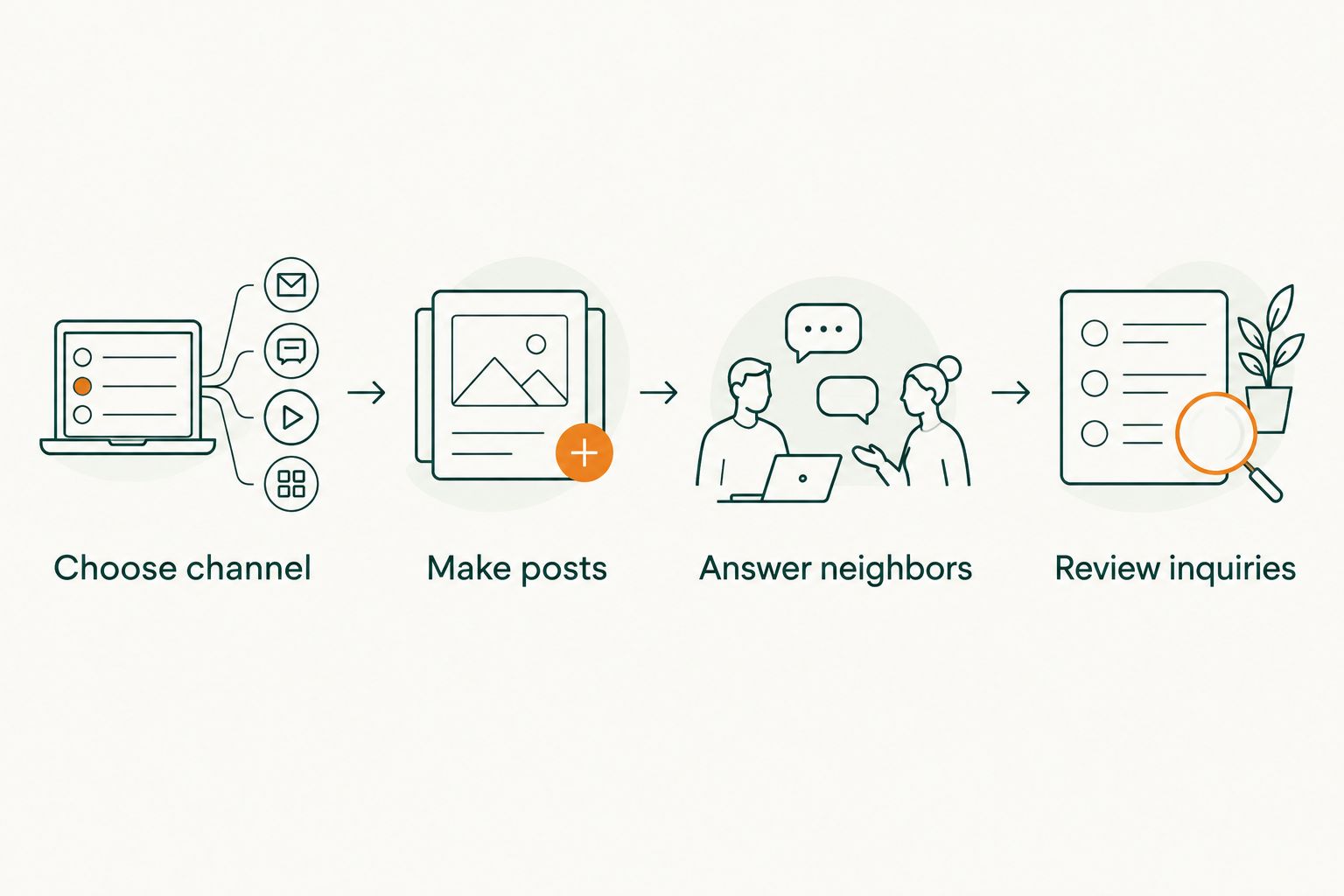
- Choose channel: Pick Facebook for a flexible starting point, Instagram for visible work, or Nextdoor for relevant neighborhood discussion. Choose TikTok or LinkedIn only when their specific use cases fit.
- Make posts: Set a manageable goal of 2 posts per week. Answer a real customer question, show something current, or explain an upcoming event.
- Answer neighbors: Set aside 15 minutes per day to check for questions on the channel you chose. If you cannot reply that often, set a schedule you can keep instead.
- Review inquiries: Note which conversations led to a visit, booking request, or direct question. Ask customers where they found you rather than crediting a platform by guesswork.
The plan also leaves room for directory discovery. HometownFirst gives a local business another place to list its profile, specials, and events. Keep those details aligned with what you say on social media so a neighbor who discovers you in either place gets a clear picture of the business.
How these platforms were ranked
This ranking puts local relevance and a manageable workload ahead of novelty. Facebook comes first because its mix of updates, events, and conversation suits the broadest range of the local business examples here. Instagram takes the next slot for businesses customers can judge by sight; Nextdoor takes the neighborhood conversation slot. TikTok and LinkedIn serve narrower needs.
That does not make Facebook the right answer for every owner. The strongest channel is the one where your business has something useful to say, your customers have a reason to respond, and you can keep the information current. HometownFirst complements that work through directory discovery rather than competing for the same posting time.
Which social media platform should you choose?
Choose Facebook if you are undecided. It covers everyday updates without requiring you to produce video, and you can use it to answer customer questions. Choose Instagram instead if your work is easiest to understand by looking at it. Choose Nextdoor when joining relevant neighborhood conversations is the main job.
Do not open TikTok or LinkedIn just to fill out a list of accounts. In 2026, a maintained presence on one fitting platform is a better plan than several profiles with stale details. Pair social posting with an accurate HometownFirst listing if you want nearby customers to find your business through local directory search as well.
FAQ
What is the best social media platform to promote a local business in 2026?
Facebook is the best general starting point for a local business in 2026. Its mix of updates, events, and conversations fits businesses that do not want to rely on video alone.
Is Instagram or Facebook better for a local shop?
Instagram is better when photos show shoppers what makes the shop worth visiting; Facebook is better for a broader mix of updates and conversations. Choose the one you can keep current.
Is Nextdoor useful for promoting a local service business?
Nextdoor is useful when a service business can answer relevant neighborhood questions. Follow community rules and make the reply helpful before mentioning your business.
Should a local restaurant use TikTok?
A local restaurant should use TikTok when it can regularly make short videos that show something customers care about. Start with one repeatable format rather than posting simply because the platform is popular.
Is LinkedIn a good choice for a local business?
LinkedIn is a good choice when your local customers or referral partners are other professionals. It is a weaker first choice for a business focused on everyday consumer visits.
Can a business directory replace social media?
No. HometownFirst helps people search for local businesses and lets owners list profiles, specials, and events; social media is where you publish updates and join conversations. Use each for its own job.
How many social media platforms should a small business manage?
Start with one primary platform that fits your customers and content. Add another only when you can keep the first account current and respond to inquiries.
One last thing
The post that earns a customer’s question matters more than the account that looks busiest. Before you publish, ask whether someone nearby can tell what you offer and what to do next. If the answer is no, fix the post before adding another platform.