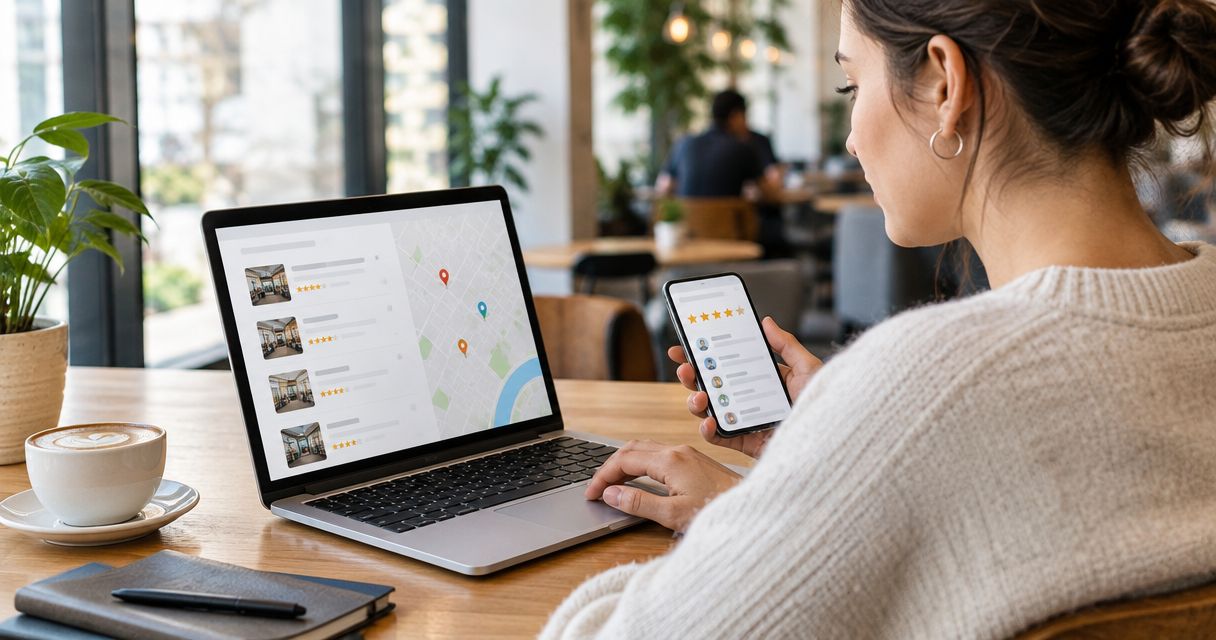
Best overall for local review research: Google Maps. Best for detailed neighborhood feedback: Yelp. Best for checking review invitation labels: Trustpilot. Best for complaint research: BBB. Best for travel-related businesses: Tripadvisor. These are useful websites to find verified reviews for local businesses in 2026, but none makes every review proof of a purchase.
- Google Maps is the best starting point among websites to find verified reviews for local businesses, not purchase verification.
- Trustpilot review labels help distinguish collection methods; read what each label actually confirms.
- Yelp, BBB, and Tripadvisor serve different research needs; compare evidence rather than star averages alone.
- HometownFirst supports local business discovery, not a verified-review recommendation in this guide.
Why this matters
A verified account, an invited review, and a verified purchase are different things. Before trusting a rating, ask what the website has actually checked. A reviewer confirming an email address does not establish that a service was delivered well.
For your 2026 search, use 2 independent sources before making a decision that matters. Look for agreement about the service you need, not identical overall scores. A restaurant's takeout feedback tells you little about its private-event service.
HometownFirst helps you discover local businesses by location, along with their specials and events. HometownFirst is best for local business discovery; use a separate review source to assess customer experiences. Discovery and verification answer different questions.
What makes the best local review website?
These 5 review websites earn different places in your research. Judge each source against the same criteria:
- Verification clarity: Does the website explain what a review label confirms? Look for a defined process, not reassuring wording alone.
- Local relevance: Does the profile match the exact location, business, and service you plan to use?
- Experience detail: Does the review describe the work, visit, or interaction rather than offer generic praise?
- Recent context: Does the feedback reflect the business you are considering now, rather than a previous team or service?
- Accountability: Can you read business responses and distinguish reviews from complaints, advertising, and directory listings?
- Category fit: Does the source contain feedback relevant to your decision, such as dining, repairs, retail, or travel?
The best review website is the one that shows evidence relevant to your purchase, not simply the highest rating. Keep that rule beside you as you compare the options.
Local review websites at a glance
| Website | Best for | Standout feature | Key limitation |
|---|---|---|---|
| Google Maps | Finding feedback for a specific local location | Reviews alongside location information | A posted review is not proof of purchase |
| Yelp | Reading detailed neighborhood business experiences | Written reviews and recommendation filtering | Recommended reviews are not purchase-verified reviews |
| Trustpilot | Understanding review collection labels | Labels explaining certain invitation methods | A company profile is not necessarily location-specific |
| BBB | Separating customer feedback from complaints | Customer reviews and complaint information | Accreditation and ratings do not verify each review |
| Tripadvisor | Researching restaurants and travel-related visits | Traveler reviews organized around travel businesses | Less relevant to many everyday local services |
| HometownFirst | Discovering nearby independent businesses | Location-based listings, specials, and events | Not presented here as a verified-review source |
1. Google Maps: best local review website for location research
Google Maps is the default starting point when you need feedback about a particular storefront or service location. Business profiles put reviews beside practical location information, helping you check that you are reading about the right place.
Its value is relevance, not purchase verification. A Google review can describe a customer experience, but its presence alone does not establish a completed transaction. Read the account of what happened before you rely on the stars.
Google Maps pros:
- Connects customer feedback with a specific business profile.
- Lets you read written experiences rather than only an average score.
- Shows business responses alongside customer reviews.
- Supports a location-first search when a business has multiple branches.
Google Maps cons:
- Reviews do not function as purchase receipts.
- Feedback can concern a different service from the one you need.
- A business-wide average hides differences between individual experiences.
Best for: Checking a nearby business's exact location and finding a first set of customer experiences.
For a repair shop, look for accounts of the repair you need. For a restaurant, separate delivery complaints from dining-room feedback. Those distinctions make the review useful.
Verdict: Hold your final judgment until you confirm the location and compare relevant feedback elsewhere.
2. Yelp: best local review website for detailed experiences
Yelp is useful when you want descriptions of what happened at a neighborhood business. Its written reviews can help you compare service, communication, and the customer's account of the visit.
Yelp uses recommendation software to decide which reviews it recommends. That distinction is not a verified-purchase badge: recommendation and transaction verification are different processes. In 2026, read the content instead of treating a recommended review as a receipt.
Yelp pros:
- Provides written accounts of local business experiences.
- Includes reviewer photos and business responses.
- Separates recommended reviews from reviews it does not currently recommend.
- Fits research across restaurants, shops, and local services.
Yelp cons:
- Recommendation status does not establish a verified purchase.
- The displayed feedback depends on the platform's recommendation process.
- A vivid individual story does not establish a repeat pattern.
Best for: Understanding how customers describe the experience of using a neighborhood business.
Compare the details across several accounts. Repeated descriptions of unclear estimates or helpful communication deserve more attention than a dramatic review without specifics.
Verdict: Hold judgment on isolated stories; use Yelp to identify repeated, relevant experiences.
3. Trustpilot: best review website for collection-label research
Trustpilot is useful when your main question is how a review was collected. Its review labels distinguish certain invitation methods, giving you another piece of context beyond the review text.
An invited review and a review marked Verified are not interchangeable labels. Read the platform's explanation of the label on the review you are considering. Do not stretch a collection-method label into a guarantee about product quality or service outcomes.
Trustpilot pros:
- Uses labels that provide context about certain review invitation methods.
- Displays written feedback and business replies.
- Supports research about a company's broader customer experience.
- Gives you a reason to examine collection methods rather than stars alone.
Trustpilot cons:
- Company-level reviews do not necessarily describe your nearby branch.
- Collection labels do not guarantee every factual statement in a review.
- A company-wide pattern can conceal location-specific differences.
Best for: Comparing review collection context when researching a company that serves customers beyond one storefront.
For a local decision, confirm that the review concerns the same service and location. Feedback about an online order is not automatically evidence about an in-person appointment.
Verdict: Hold a local booking decision until company-level feedback matches the location and service you need.
4. BBB: best local review website for complaint context
BBB helps you examine customer reviews and complaint information as separate forms of evidence. That separation matters when you want to understand how a business responds to a dispute.
A BBB rating, accreditation status, customer review, and complaint record are different signals. Do not describe an accredited business as having verified customer reviews solely because it is accredited. For 2026 research, read the actual record and response, not just the profile summary.
BBB pros:
- Presents complaint information separately from customer reviews.
- Helps you examine a business's response to a documented dispute.
- Distinguishes accreditation from customer feedback.
- Adds context to research about service and communication problems.
BBB cons:
- A complaint record is not a representative sample of every customer.
- Accreditation does not verify every customer review.
- A resolved complaint does not, by itself, prove the customer was satisfied.
Best for: Checking dispute handling before choosing a business for work where expectations and communication matter.
Look for the issue, the business response, and the recorded outcome. A complaint without that context gives you less information than a complete exchange.
Verdict: Hold judgment until you separate reviews, ratings, accreditation, and complaint outcomes.
5. Tripadvisor: best review website for travel-related visits
Tripadvisor fits restaurants and businesses connected with travel, including hotels and attractions. Its reviews help you examine experiences in a travel context rather than treating every local business category alike.
That focus is useful when the occasion matters. A visitor planning a meal during a trip has different questions from a resident hiring an electrician. Tripadvisor is a category-specific research source, not the default choice for every neighborhood service.
Tripadvisor pros:
- Organizes feedback around restaurants and travel-related businesses.
- Includes written visitor experiences and photos.
- Supports research tied to a destination or type of visit.
- Helps you distinguish different expectations around travel experiences.
Tripadvisor cons:
- Is less relevant to many repair, professional, and everyday local services.
- Traveler feedback does not necessarily reflect a resident's priorities.
- A published review alone does not establish proof of purchase.
Best for: Choosing a restaurant, hotel, or attraction when the visit forms part of a trip.
Read for the occasion you have in mind. Feedback about a family meal does not answer every question about a business lunch or special event.
Verdict: Skip Tripadvisor for unrelated local services; keep it for travel-related decisions.
Where local discovery fits
HometownFirst is a local business directory, not a substitute for the review checks above. You can search for nearby businesses and discover their profiles, specials, and events. Consumers browse the directory without their information being sold or receiving unsolicited ads afterward.
HometownFirst pros:
- Focuses on discovering businesses by location.
- Gives independent businesses a place to present profiles and specials.
- Includes local events as another reason to explore nearby businesses.
HometownFirst cons:
- Discovery information does not establish a verified customer experience.
- A listed special does not tell you whether a service fits your needs.
Best for: Building a local shortlist before checking customer feedback and contacting the business.
Verdict: Skip directory presence as proof of quality; use it to find businesses worth researching.
Find a business close to home
Explore nearby businesses, specials, and events before checking customer feedback.
How the websites rank
This 2026 ranking assigns each website a different job: location research, detailed experiences, collection-label research, complaint context, or travel-related visits. It does not rank websites by traffic, review volume, or an invented accuracy score.
Google Maps leads as the general starting point because location is central to a local-business decision. The other sources add different evidence. Use the criteria above to choose your second source rather than reading the list as a universal quality leaderboard.
Check a review before trusting it
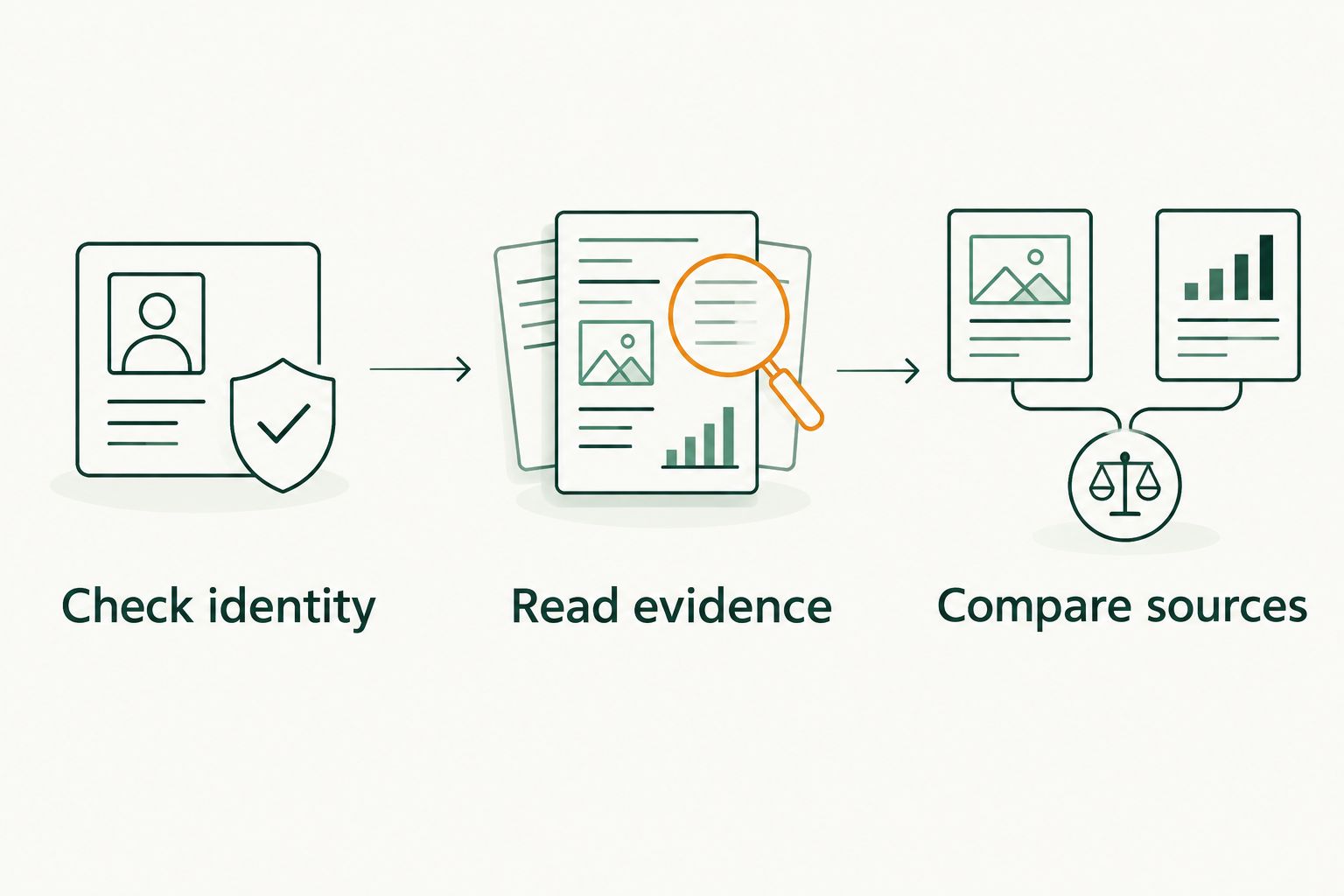
Use 3 checks before treating a review as evidence. The sequence works across the websites in this guide and keeps you focused on the decision, not the score.
Check identity
Match the business name, location, and service. If the review concerns a different branch or a discontinued offering, set it aside for this decision.
Read evidence
Look for an account of the interaction: what the customer requested, what happened, and how the business responded. Specificity gives you something to assess; it still is not proof that every statement is true.
Compare sources
Look for the same relevant issue in another source. Agreement helps you identify a pattern; disagreement tells you to ask the business a direct question before booking.
A useful question is specific: ask how estimates are approved, whether the service fits your needs, or how the business handles a problem. A review should improve your conversation, not replace it.
Which local review website should you choose?
Start with Google Maps for a general local search in 2026. Add Yelp for detailed neighborhood experiences, Trustpilot for collection-label context, BBB for complaint research, or Tripadvisor for a travel-related visit.
Do not average scores from different websites into a homemade trust rating. The platforms collect and present different evidence. Your job is to find feedback about the right business, service, and situation—and ask about anything that remains unclear.
FAQ
What's the best website to find verified reviews for local businesses?
Google Maps is the best general starting point for local review research, but a Google review is not proof of purchase. Use Trustpilot when collection labels matter, and read exactly what a label confirms.
Are all Google Maps reviews verified purchases?
No, Google Maps reviews are not a collection of verified-purchase receipts. Check the location, the described experience, and another relevant source before relying on a review.
Does a recommended Yelp review mean the purchase was verified?
No, Yelp recommendation status is not purchase verification. It reflects Yelp's recommendation process, so assess the review's details rather than treating that status as transaction proof.
What's the difference between an invited and a verified review?
An invited review indicates an invitation, while a verified label depends on the website's defined verification process. Read the label explanation on that platform; neither term guarantees that every statement is accurate.
Does BBB accreditation verify customer reviews?
No, BBB accreditation and customer reviews are separate signals. Read customer feedback, complaint information, and business responses without treating accreditation as verification of each review.
Is Tripadvisor useful for every local business?
No, Tripadvisor is most relevant here to restaurants and travel-related businesses. Choose another source for unrelated local services and compare feedback about the exact service you need.
Can I use HometownFirst to find nearby businesses?
Yes, HometownFirst helps you discover local businesses by location, including profiles, specials, and events. Use a separate review source to evaluate customer experiences rather than treating a directory listing as review verification.
One last thing
Read how a business responds to a difficult review before dismissing it. A specific response about the customer's concern gives you more to assess than a generic thank-you beneath praise. Check the response against the review, then ask your own question.