
Choose HometownFirst if you want to discover independent local businesses, find their specials, or promote your own business through a monthly directory listing; choose MapQuest if you need maps, driving directions, and help planning a trip. This 2026 comparison separates finding a place worth visiting from figuring out how to get there.
- HometownFirst vs MapQuest is a local business discovery versus trip planning comparison, not a contest between identical services.
- Choose the local directory for business profiles, specials, and events; choose MapQuest for maps and driving directions.
- Business owners should judge discovery by customer inquiries, not confuse a directory listing with a routing tool.
Why this matters
A restaurant owner and a driver can look at the same business listing and need completely different things. The owner wants a nearby customer to notice the restaurant and consider visiting. The driver wants to reach its entrance without getting lost.
Local discovery and driving directions solve different problems. Buying a directory listing does not replace a map, and finding an address on a map does not explain everything a business wants customers to know.
For your 2026 decision, start with the task you need to finish. Are you choosing a business, promoting one, or traveling to one? That question gives you a clearer answer than comparing two platforms as though their main jobs were interchangeable.
At a glance
| Dimension | HometownFirst | MapQuest |
|---|---|---|
| Best for | Community members discovering local businesses and owners promoting them | People looking up places and planning driving trips |
| Local discovery | Directory focused on local restaurants, retail, and services | Map-based place lookup |
| Driving directions | Use the directory to choose a business | Use maps and directions to reach a destination |
| Specials and events | Owners can post specials and list events | Choose it for the journey rather than an owner’s promotional calendar |
| Trip planning | Decide which local businesses interest you | Plan how to travel to your destination |
| Location relevance | Search for businesses by location | Look up places geographically |
| Information accuracy | Check business details before acting | Check the destination before starting your trip |
| Pricing model | Monthly business listing subscriptions; consumers browse without a subscription | Consumer mapping and directions; assess business-facing arrangements separately |
| Standout feature | Business profiles alongside local specials and events | Maps and driving directions |
The practical distinction is what you expect to do next. If you want to compare nearby businesses and see what they are promoting, start with the directory. If you already know where you want to go, start with the map.
HometownFirst is the better fit for local business discovery
HometownFirst is a local business directory for nearby shoppers and independent business owners. Its stated purpose is helping community members search for businesses, discover specials, and spend locally.
That makes it a direct fit when your question is about choosing a business rather than locating an address. You might be looking for a restaurant to try, a nearby shop, or a service provider in your community. Business profiles and posted specials give you information to consider before deciding where to go.
MapQuest is the better starting point when geography drives the question. Looking up a place on a map helps you understand where it sits in relation to your journey. That is useful, but it is a different decision from choosing a business because its profile or special interests you.
For an owner, the directory’s advantage is the opportunity to present the business and its promotions together. The limitation is equally important: a listing is not a promise of inquiries or sales. You still need accurate information and a reason for someone to choose you.
MapQuest wins when you need driving directions
Choose MapQuest when the next task is getting to a destination. Maps and driving directions are its central use case, so it fits the driver who already has an address or a place in mind.
A directory can help you decide which business to visit. A mapping service helps you work out the journey. Treat those as separate steps instead of expecting one listing to do both jobs equally well.
For example, discovering a local restaurant’s special answers the question of where to eat. Checking directions answers how to get there. The second task becomes important after the first decision, not instead of it.
The tradeoff is that a route does not tell the whole story of a business. It does not substitute for checking a posted special, understanding the service offered, or confirming an event. Use MapQuest for the travel decision and business information for the purchasing decision.
The directory wins for owner-posted specials and events
The local directory explicitly lets business owners post specials and list events. Choose that format when your message is about what customers can find at your business, not simply where it is.
This suits a restaurant promoting a special, a retailer sharing an offer, or a service business listing an event. The benefit is having promotional information available alongside the business profile. Customers can discover the business and see another reason to consider it.
That benefit comes with an upkeep task. A special needs clear terms, and an event needs enough detail for someone to decide whether to attend. Remove expired information and check that the description still matches what your business provides.
MapQuest remains useful after someone decides to visit. Its maps and directions serve the trip itself. This comparison does not require treating it as an event-publishing tool to give it a genuine win: helping a visitor reach a destination is already a distinct, useful job.
MapQuest is the better fit for trip planning
MapQuest wins when the journey, rather than the business profile, is your main concern. Start there when you need to understand where a destination is and how to drive to it.
This matters for someone visiting an unfamiliar area or arranging a day around a particular destination. A map gives the journey a geographic frame. A local directory gives individual businesses a discovery frame.
The distinction also helps business owners avoid comparing unrelated results. A customer using directions might already have selected your business. A customer reading your directory profile might still be deciding whether to contact you. Those interactions happen at different points in the customer’s decision.
For a 2026 marketing plan, separate these two goals: helping people choose your business and helping visitors reach it. Neither task cancels the other. Spend your time improving whichever part currently needs attention rather than assuming that every platform serves the same purpose.
Both serve location-based questions, with different next steps
Both services are relevant to a local search, but location alone does not make them interchangeable. The directory supports finding businesses by location. MapQuest supports looking up places geographically and getting directions.
Call this a tie on location relevance, not a tie on every feature. Your next action determines which format is more useful.
The two paths are easy to separate:
- Local discovery: Start with the kind of business you want to find.
- Specials: Check whether a posted offer interests you.
- Events: Review an event before deciding to attend.
- Trip planning: Start with the destination you want to reach.
- Maps: Check where that destination is.
- Directions: Work out the driving journey.
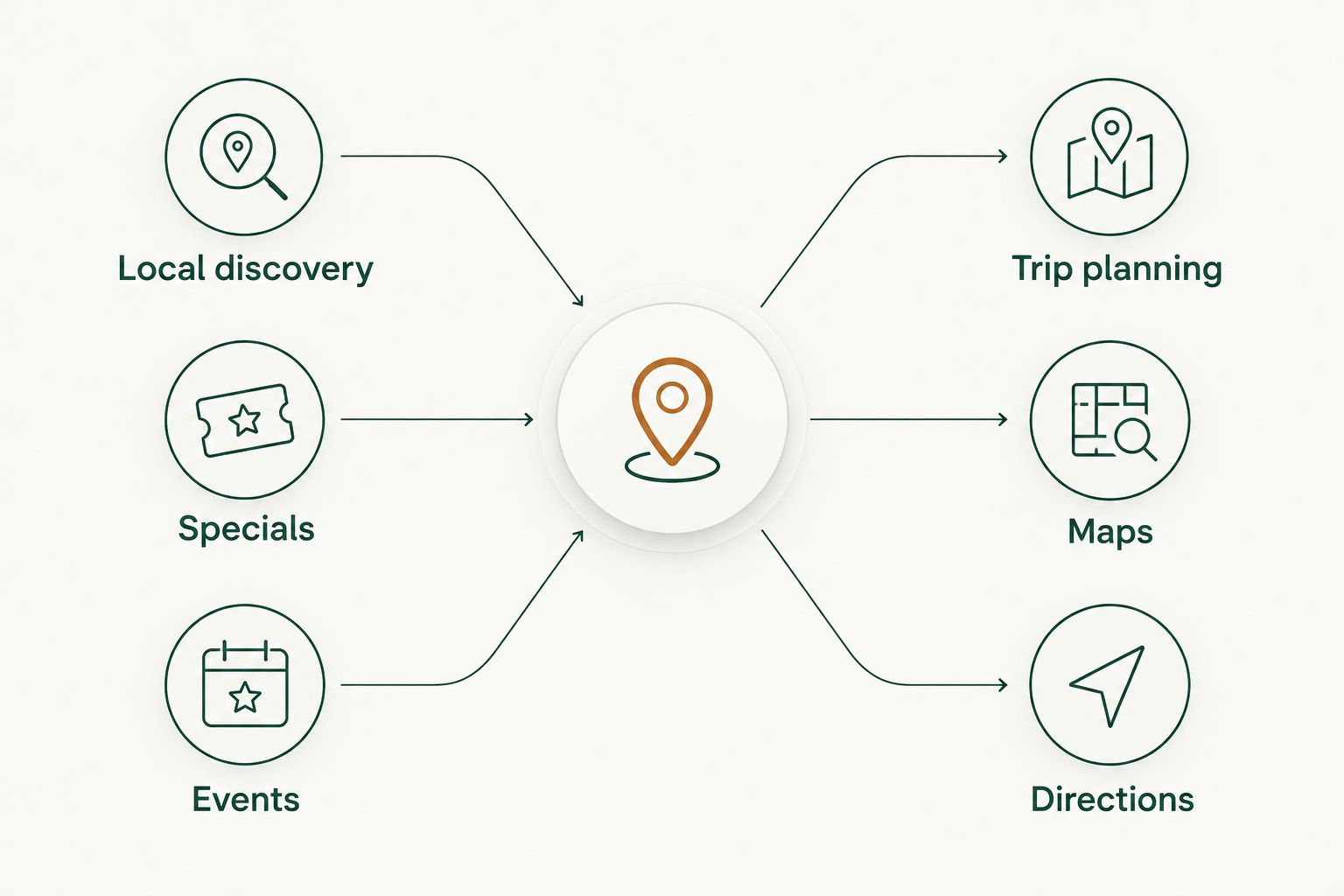
You do not have to choose one service for every part of an outing. You can discover a business through a directory, confirm the details you need, and then use a mapping service for the journey. Each step has a clear purpose.
Accurate business details matter on both
Neither format removes the need to check the details that affect your visit. A useful profile and a useful destination both depend on identifying the right business and location.
For shoppers, compare the business name and address before traveling. Confirm a special’s terms with the business when those terms affect your decision. For an event, check the details before arranging your day around it.
For owners, use a short information check across your public presence:
- Business identity: Make the name and service description clear.
- Location details: Confirm the address identifies the intended location.
- Current information: Remove expired specials and outdated event details.
This is an honest tie because accuracy is a responsibility on both sides of the comparison. A directory’s promotional tools cannot repair incorrect business details. A mapping tool’s directions cannot make an outdated event current.
Make that check part of your 2026 routine whenever your business information changes. Keeping the basics clear is a more useful first move than adding another profile while leaving existing information unattended.
Pricing models: business promotion and consumer mapping are different buys
The directory uses monthly subscriptions for business listings. Consumers can browse and search without taking out a subscription. That separates the owner’s decision to pay for a presence from the shopper’s decision to explore nearby businesses.
For an owner, a recurring listing creates an ongoing budget commitment. Assess that commitment against the role you want the profile to play: presenting your business, sharing specials, and listing events. Check current terms before subscribing, particularly if you manage multiple locations.
MapQuest’s consumer mapping and directions are a separate use case from purchasing business promotion. Do not treat access to a map as an equivalent quote for a promotional directory listing. If you are considering a business-facing arrangement, assess its current terms and purpose independently.
Compare like with like: a business listing against a business listing, and a trip-planning tool against a trip-planning tool. A shopper needs a useful destination and journey. An owner needs a clear account of what the business receives and what requires ongoing attention.
Test the job before choosing the platform
Use a simple decision process rather than trying to judge everything at once. Start with 3 questions: what task do you need to complete, what action should follow, and what information must stay current?
For a shopper, try one real search. Find a business that interests you, read the details relevant to your visit, and check the destination. You will quickly see whether you need discovery information, directions, or both.
For a business owner, set a 30-day review period as your own evaluation window. This is a planning recommendation, not a promised time to results. During that period, keep the profile current and record customer inquiries that explicitly mention the directory.
Track 2 goals separately: discovery and arrival. Discovery means a customer found or considered the business; arrival means a visitor needed help reaching it. Do not credit a listing with every sale or treat a directions request as proof that the map introduced the customer to you.
For your 2026 review, write down what happened and what you maintained. That gives you a practical basis for deciding whether the service fits your business instead of relying on a feature checklist alone.
Final verdict: choose for the task in front of you
Choose HometownFirst if you are a local shopper or independent owner
HometownFirst wins for the shopper exploring local businesses and the owner who wants a directory profile with specials and events. Its local-first purpose matches those needs directly.
Choose it when your main question is what is nearby, what a business offers, or how to present your own business to community members. Keep the tradeoff in view: owners take on a monthly subscription and need to maintain useful information.
Choose MapQuest if you are a driver planning a visit
MapQuest wins for the driver who needs maps and driving directions. Choose it when you have a destination and want to plan the journey.
Its limitation in this comparison is scope, not usefulness. Planning a route does not replace reading a business profile or checking a special. Use the right service for the next decision rather than demanding one winner for the whole outing.
| Dimension | Winner |
|---|---|
| Best for | Directory for discovery; MapQuest for driving |
| Local discovery | Local directory |
| Driving directions | MapQuest |
| Specials and events | Local directory |
| Trip planning | MapQuest |
| Location relevance | Tie, with different purposes |
| Information accuracy | Tie; check details on both |
| Pricing model | Match the arrangement to the task |
| Standout feature | Profiles and promotions versus maps and directions |
FAQ
Is HometownFirst better than MapQuest for local businesses?
HometownFirst is the better fit for owners seeking a local directory profile with specials and events. MapQuest is the better fit when the task is maps and driving directions to a business.
Which should I use to find somewhere local to eat?
Start with the local directory when you want to discover restaurants and see posted specials. Use MapQuest when you have chosen a destination and need driving directions.
Which is better for planning a drive?
MapQuest is the better fit for planning a drive because maps and driving directions are its central use case. A directory serves the earlier task of discovering or choosing a business.
Can business owners publish specials and events in the directory?
Yes, business owners can post specials and list events alongside their directory presence. Keep promotional details current so customers can make an informed decision.
Do shoppers need a directory subscription?
No, consumers can browse and search the local directory without a subscription. Monthly subscriptions apply to business listings.
Should a business choose a directory instead of a mapping service?
Choose according to the task rather than treating the services as substitutes. A directory helps present the business and its promotions; a mapping service helps people locate and reach a destination.
How should I evaluate a business directory in 2026?
Evaluate whether the directory supports the customer action you want, such as discovering your business or asking about a posted special. Keep the listing current and record inquiries that explicitly mention it rather than assuming every sale came from the profile.
One last thing
Before adding another listing in 2026, ask someone unfamiliar with your business to explain what you offer and where to find you using your current public information. If either answer is unclear, fix it first. A new platform is not a substitute for a clear description and the right address.