
Choose HometownFirst if you want a local business directory built around independent businesses, specials, and events; choose Yellow Pages if you want straightforward business lookup rather than a local-deals destination. This 2026 comparison separates those two jobs so you can choose the right directory as a shopper or business owner.
- HometownFirst vs Yellow Pages comes down to community discovery versus straightforward business lookup.
- Choose the local-first directory for independent businesses, specials, and events.
- Choose Yellow Pages when your task is finding an existing business listing and its contact details.
- Neither local business directory guarantees customers; judge results by relevant inquiries and visits.
Why this matters
A directory can help you find a business, but finding a business and deciding where to spend are different tasks. Someone searching for a repair shop's phone number needs an accurate listing. Someone choosing where to eat wants reasons to consider one nearby restaurant over another.
The same distinction matters when you own the business. A listing that provides contact details serves a different purpose from a profile you keep current with specials and events. Choose the job before choosing the platform.
For this 2026 comparison, Yellow Pages means the online business directory, not a printed phone book. The decision concerns local discovery and business listings, not an assessment of every advertising service offered under the Yellow Pages name.
At a glance
| Dimension | HometownFirst | Yellow Pages |
|---|---|---|
| Best for | Independent businesses and shoppers interested in spending locally | People looking up businesses by category and location |
| Local search | Location-based discovery across restaurants, retail, and services | Category-and-location business lookup |
| Direct lookup | A place to discover and inspect local business profiles | A good fit when you want an existing business listing's contact details |
| Specials and events | Owners can post specials and list events | Choose primarily for directory lookup; check individual listings for additional information |
| Consumer privacy | Free browsing, no selling consumer information, and no unsolicited ads afterward | Check the current privacy policy before submitting personal information |
| Owner workload | Monthly subscription listing with profiles, specials, and events to maintain | A contact-focused listing suits owners whose main task is keeping business details accurate |
| Pricing model | Monthly subscription listings, with separate charges for additional locations | Evaluate the listing or advertising arrangement offered before committing |
| Standout feature | A stated focus on local spending and stronger communities | A familiar category-based approach to finding businesses |
The table is a fit comparison, not a traffic ranking. It does not establish which directory brings more customers to your particular business. That answer requires results from your own location and listing.
The local-first directory wins for community-focused discovery
HometownFirst is best for independent businesses that want a local directory supporting discovery, specials, and events. Its stated purpose is to connect nearby customers with local businesses and encourage spending within the community.
That is a clear fit for a shop with something new to share, a restaurant posting a special, or a service business building a local presence. The directory gives owners places to describe their business and publish those updates. You still need to make the information useful.
The advantage is the match between the platform's purpose and your goal. If you want shoppers to consider local options rather than simply retrieve a telephone number, community discovery is the relevant starting point.
The limitation is equally important: a local-first mission is not evidence of customer volume. Before making a subscription decision, search your area and category, inspect the experience, and decide whether it serves the customers you want to reach.
Both directories serve location-based business search
Both options belong to the local business directory category. You can approach either with a location and the kind of business you need. For a straightforward search, accuracy and relevance matter more than the directory's name.
As a shopper, check that a result actually serves your area. A business listed near you is not necessarily the right fit for your request, especially when the service happens at your home or another location.
As an owner, keep your business name, location, contact information, and description consistent with the details customers see elsewhere. A directory profile should remove uncertainty, not introduce another version of your business identity.
Neither option deserves an automatic win on local search alone. Compare the actual results for your town and category. An accurate, relevant listing is useful; an unrelated result is not, regardless of which directory displays it.
Yellow Pages fits direct contact lookup better
Yellow Pages is the better fit when you already want a conventional business-directory search: choose a category, choose an area, and inspect the resulting business information. You do not need a community-shopping angle to complete that task.
Consider a customer trying to contact a specific service provider. Specials and events are secondary. The important questions are whether the business is the right one and whether its contact details are current.
This is a genuine reason to choose Yellow Pages, but it is not a claim that every search result is more accurate or complete. The individual listing still needs checking. Confirm important details with the business before making a trip or arranging work.
For an owner, start by finding your existing listing. Inspect what a customer sees before deciding whether the directory deserves additional attention. That simple check is more useful than assuming that a recognizable directory name guarantees a useful presence.
Specials and events favor the local-first directory
The local-first platform explicitly lets owners post specials and list events. That gives it a clear fit when your directory presence needs to communicate more than your business category and contact details.
A useful special explains what the customer should do next. A useful event listing explains what is happening and where. Neither needs exaggerated promises; it needs enough detail for someone nearby to decide whether to participate.
Use these distinctions when preparing your listing:
- Business profile: Explain what you do and who you serve.
- Specials: Describe the current offer accurately and include its conditions.
- Events: Give customers the information they need to attend.
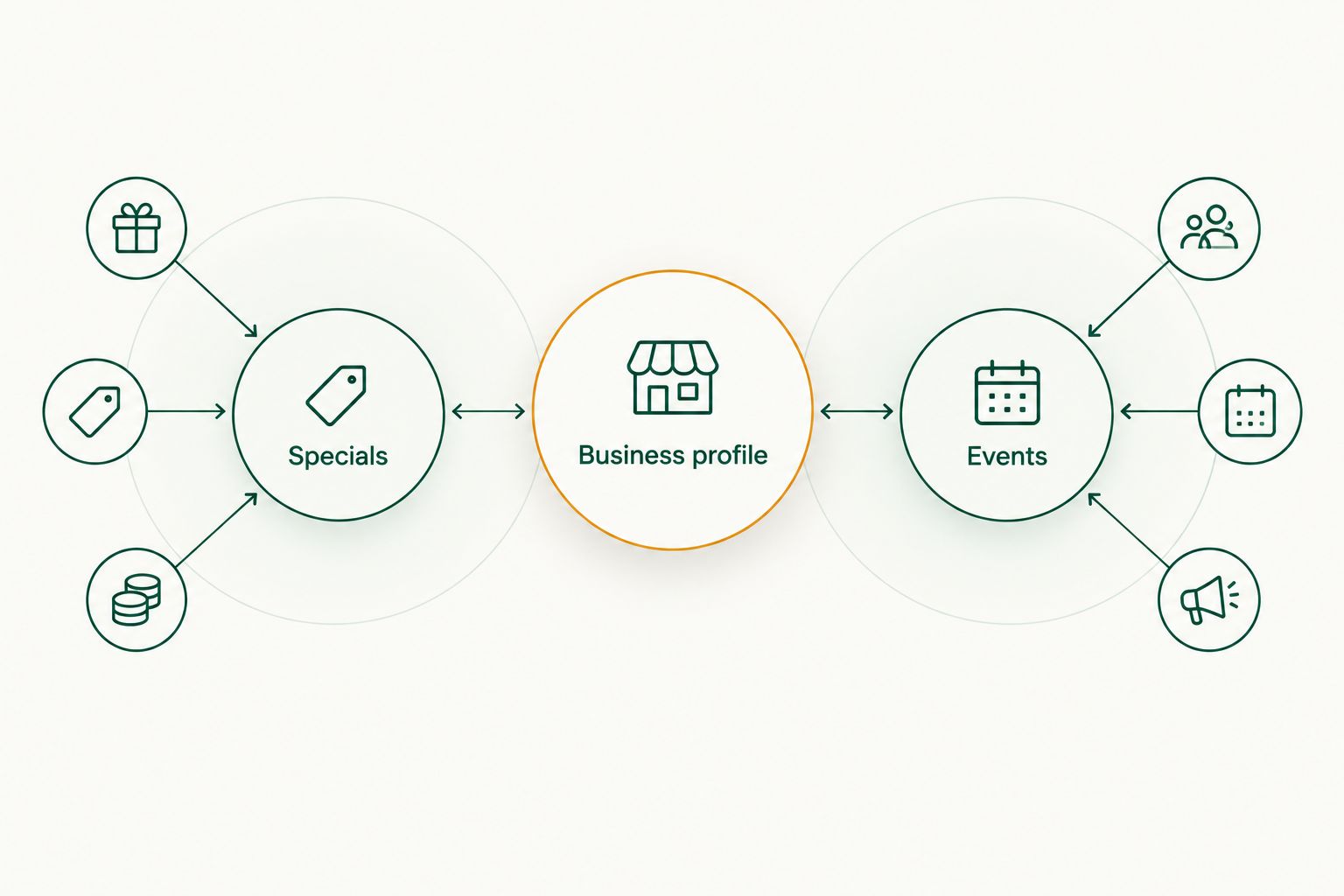
The tradeoff is maintenance. An expired special or incomplete event description weakens the usefulness of the listing. Choose these features when someone in your business can keep them current, not simply because they appear on a feature list.
Yellow Pages remains a reasonable choice when basic business lookup is your main requirement. Do not treat it as the winner or loser on promotions without checking what the particular listing or service you are considering includes.
The local-first platform makes a clear consumer privacy promise
The local-first directory states that consumers can browse and search without paying, that it does not sell their information, and that browsing does not lead to unsolicited ads afterward. Those commitments directly address concerns a shopper can have about using a discovery service.
That stated privacy approach is a reason to choose the platform. It is not evidence that Yellow Pages sells information or sends unwanted advertising. A fair comparison does not turn one company's commitment into an unsupported accusation about another.
For your 2026 decision, read the current privacy policy before submitting personal details to any directory. Browsing public listings, creating an account, and contacting a business are different actions; understand what you are agreeing to at each point.
Business owners should also distinguish consumer privacy from their own listing responsibilities. Information intended for public customer contact belongs in a business profile. Personal details that customers do not need should stay out of the public description.
Yellow Pages suits a contact-first maintenance task
Yellow Pages is a practical choice when your immediate goal is checking a conventional listing and keeping its business details accurate. That is a narrower task than running a profile with a continuing stream of specials and events.
The difference concerns your workflow, not a measured comparison of the platforms' administrative tools. A contact-first listing asks you to focus on essential details. A promotion-focused presence gives you additional information to maintain.
Choose the contact-first approach if your business has no current specials or events to publish and customers mainly need to know what you do and how to reach you. There is no benefit in creating promotional work that does not serve a real customer need.
The local-first subscription makes more sense when you plan to use its broader listing purpose. Its limitation is that useful features still require useful content. Publishing a vague profile and leaving it unchanged does not fulfill that purpose.
Compare subscription commitments, not just listing features
The local-first directory sells monthly subscription listings to businesses. The first location and additional locations carry separate charges, so a business with several locations should assess the commitment across its whole footprint.
That model gives you a recurring listing expense to evaluate against your results. It also makes location-level accuracy important: each profile needs to represent the right place, not merely repeat a generic company description.
For Yellow Pages, separate the business listing you want to maintain from any advertising arrangement you are considering. Ask what the proposed arrangement includes, how billing works, and what obligations apply. Do not assume a directory listing and an advertising purchase are the same decision.
Before committing in 2026, check:
- Which business locations the arrangement covers.
- Which profile or promotional functions it includes.
- Who can update the information.
- Whether there is a minimum commitment.
- How renewal and cancellation work.
- What reporting is provided, if any.
These are questions to resolve before signing, not promises about either platform's terms. Choose a predictable recurring commitment only when the listing serves a clear business purpose you can assess.
Their standout strengths answer different questions
The local-first platform answers: where can I discover independent businesses and reasons to spend nearby? Yellow Pages answers: where can I look up a business in a category and location?
Both questions are useful. Neither directory replaces the business's responsibility to explain its services, respond to customers, or deliver what its listing promises.
For your 2026 evaluation, inspect each directory as a customer would. Search your category, open relevant profiles, and ask whether the information supports a real next step. A platform's positioning helps you choose where to look; the listing itself determines whether the experience is useful.
Final verdict: choose according to the customer's task
Choose HometownFirst if you run an independent local business
The local-first directory wins for the owner who wants a subscription profile with specials and events. It also fits shoppers who want a platform explicitly focused on supporting local spending.
Choose it because you intend to use that purpose and those functions. Do not choose it on an assumption of guaranteed inquiries, sales, or search rankings.
Choose Yellow Pages if you need conventional directory lookup
Yellow Pages wins for the contact-first searcher looking for business information by category and location. It also suits an owner's immediate task of inspecting an existing listing for accuracy.
Choose it when that narrower job matches your needs. Evaluate any additional advertising proposal separately rather than treating directory familiarity as proof of business results.
| Dimension | Winner |
|---|---|
| Community-focused discovery | Local-first directory |
| Location-based business search | Tie; inspect actual results |
| Direct contact lookup | Yellow Pages for the contact-first task |
| Specials and events | Local-first directory |
| Explicit consumer privacy commitment | Local-first directory; no competitor inference |
| Contact-first maintenance task | Yellow Pages for the narrower workflow |
| Pricing model | No universal winner; compare commitments |
| Standout feature | Local discovery or conventional lookup, according to the task |
FAQ
Is HometownFirst better than Yellow Pages?
HometownFirst is the better fit for independent businesses wanting local discovery, specials, and events; Yellow Pages fits conventional business lookup. Choose according to the customer task, not an assumption that either directory guarantees sales.
Which directory should I use to find a local business?
Use Yellow Pages for conventional category-and-location lookup, or the local-first directory when you want community-focused discovery and specials. Check the individual listing before relying on important business details.
Can I browse the local-first directory without paying?
Yes, consumers can browse and search the local-first directory without paying. Business owners use a monthly subscription model for their listings.
Which option is better for posting specials and events?
The local-first directory is the clear fit because its stated functions include specials and event listings. Keep those posts accurate and remove information that is no longer current.
Does a business directory listing guarantee more customers?
No, a directory listing does not guarantee customers. Evaluate relevant inquiries, visits, and sales attributable to the listing rather than treating publication as a result.
How should I compare business listing costs?
Compare the recurring commitment, covered locations, included functions, and contractual terms. For Yellow Pages, clarify whether you are discussing a business listing or an advertising arrangement.
Should my business use both directories in 2026?
Use both in 2026 only if each serves a distinct purpose you can maintain and assess. Accurate contact information and useful local updates matter more than adding another neglected profile.
One last thing
Before adding a new directory commitment, search for your business as if you were a first-time customer. Read the listing without filling in the gaps from your own knowledge.
Fix the uncertainty you find before buying more visibility. A customer who cannot tell whether you serve their area or provide the service they need has a reason to move on, even after successfully finding you.