
A local business directory listing is worth it in 2026 when it brings you relevant nearby customers and enough profit to justify the subscription and upkeep. Keep a listing for the business it produces, not simply for having your name on another website; time spent maintaining it belongs in the decision, too.
- Is a business directory listing worth it? Yes, when attributable customer profit justifies the subscription and upkeep.
- Hometownfirst fits independent businesses seeking local discovery, with business profiles, specials, and events.
- Compare free business listings and paid directories by customer fit, maintenance, and measurable results.
- A directory listing does not guarantee search rankings, inquiries, or sales.
Is a local business directory listing worth it in 2026?
Yes, if the directory reaches people you serve and helps them take a useful next step. That step might be visiting your shop, booking an appointment, or contacting you about a service. A page view alone does not establish value.
Start by comparing the work and purpose of each approach. The guide to free business listing sites provides another starting point if you are deciding where to establish your presence.
| Approach | Best for | Main advantage | Main drawback | Keep it when |
|---|---|---|---|---|
| Free directory listing | Establishing basic business information | Lets you publish details without a listing subscription | Still takes time to check and maintain | The information stays useful and accurate |
| Paid directory listing | Testing an additional local discovery channel | Gives you a specific channel to assess against business outcomes | Adds a recurring commitment alongside upkeep | Attributable customer profit supports the commitment |
| No additional listing | Businesses prioritizing existing channels | Avoids another profile to manage | Leaves that directory untested | Existing channels deserve the available attention |
These are choices about where to spend your effort, not a ranking of platforms. A free listing that sends unsuitable inquiries wastes attention; a paid listing that produces profitable customers deserves a different assessment.
Why this matters
You do not need another marketing task that stays on the list because nobody knows whether it works. A directory deserves a clear job: help nearby people discover your business, understand what you offer, and decide whether to contact or visit you.
For your 2026 marketing plan, separate discovery from results. Discovery means someone encountered the listing; results mean that encounter led to an outcome your business values. Both belong in your records, but they answer different questions.
A useful decision also respects your capacity. If your team cannot keep another profile accurate or respond to the inquiries it generates, adding the listing creates work before it creates value.
Free listings: best for establishing the basics
Use a free listing to publish useful business information, not to collect another badge of online presence. Check the business name, location or service area, contact details, hours, and description before sending customers there.
The advantage is straightforward: there is no listing subscription to justify. The drawback is that setup and maintenance still require attention, and being listed does not establish that the directory reaches your customers.
Treat a free profile as a small operational responsibility. Decide who owns updates, especially when your hours, services, or contact information change. An unattended listing can point people toward details you no longer want them to use.
Paid listings: best for a measurable local discovery test
Pay for a listing when you can explain what it adds and how you will judge it. A stronger profile, a place to publish specials, or an events listing is useful only when it supports the way customers choose your business.
The benefit is having a defined channel to test. The drawback is a recurring commitment that continues whether or not you have reviewed the results. Before subscribing, check the current terms and decide what outcome would justify keeping it.
For a 2026 decision, avoid treating a subscription as permanent by default. Set a review date before starting, then assess customer fit, attributable business, and the work involved rather than renewing through habit.
No additional listing: best for protecting limited time
Wait when your existing business information needs attention before another profile would help. An outdated website, unanswered inquiries, or unclear service descriptions are reasons to fix the customer journey you already have.
Waiting protects your attention and avoids adding another recurring task. The trade-off is that you will not learn whether that particular directory brings useful customers until you test it.
This is not a recommendation to disappear from local search. It is a recommendation to finish the work closest to a customer decision before expanding the number of places you maintain.
Why a directory listing's value varies
The right question is not whether directories work in general. It is whether a particular listing performs a useful job for your business.
- Local fit: Check whether customers can find businesses by the location you actually serve. A location mismatch sends you inquiries you cannot fulfill.
- Business fit: Confirm that the directory can describe your category and services accurately. Broad exposure is not a substitute for relevant interest.
- Useful content: Decide whether profiles, specials, or events support something you already want to communicate. Do not create extra promotions merely to fill a listing.
- Maintenance effort: Include checking details, updating content, and responding to inquiries. A profile that needs attention must have someone responsible for it.
- Customer profit: Judge completed business after the costs of delivering it. Revenue alone does not tell you whether the listing pays its way.
- Attribution: Record how customers found you and distinguish known directory referrals from uncertain ones. Uncertainty is not proof of success or failure.
These factors explain why another owner's recommendation cannot settle your decision. Your service area, customer needs, and ability to maintain the listing determine whether the same approach makes sense for you.
How do you decide whether to keep a listing?
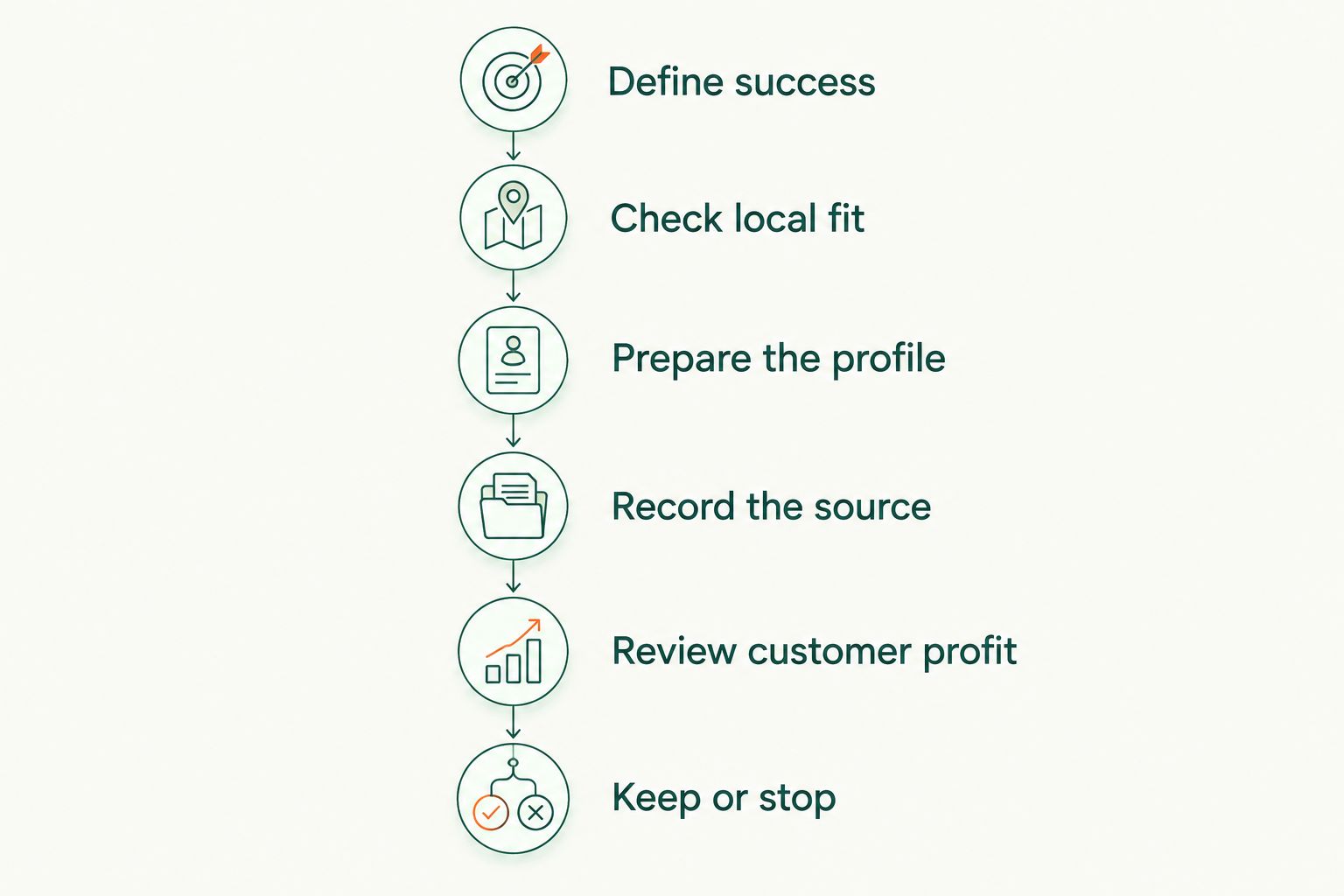
Use this process for a new listing or an existing subscription. It gives you a repeatable decision without pretending every business needs the same lead target.
1. Define success
Choose the customer action you want before you change the profile. A restaurant might track visits attributed to the directory; a service business might track suitable inquiries that become completed jobs.
Write down what makes an inquiry suitable. Someone outside your service area or asking for work you do not provide should not count as a promising result simply because they contacted you.
2. Check local fit
Look at the listing as a customer would. Can someone tell where you operate, what you do, and whether your business meets their need?
Confirm that your description matches the work you want. A vague profile makes it harder to distinguish your business from another option, even when the contact details are correct.
3. Prepare the profile
Use accurate details and a clear next step. If you want appointments, explain how to request one; if visits matter, make the location and current hours easy to understand.
Only publish a special or event when it reflects something your business is actually offering. Give yourself a reminder to remove or revise information when it stops being current.
4. Record the source
Ask new customers how they found you and record their answers consistently. If your website measurement supports referral tracking, use it alongside those answers rather than treating either source as a complete picture.
Keep unknown sources marked as unknown. A customer who remembers your business name but not where they first encountered it does not provide a confirmed directory referral.
5. Review customer profit
Connect attributable inquiries to completed business wherever your records allow. Separate inquiries that went nowhere from purchases, visits, or bookings that generated value.
Then consider the profit remaining after delivery costs alongside the subscription and maintenance work. For your 2026 review, keep the assessment tied to recorded outcomes rather than an assumed future benefit.
6. Keep or stop
Keep a listing when the evidence supports its role. Improve it when a specific problem, such as an unclear description or incorrect hours, prevents a fair assessment.
Stop or pause when the commitment is not justified and you have no clear correction to test. If the evidence remains uncertain, make that uncertainty part of the decision instead of relabeling it as success.
Where does Hometownfirst fit?
Hometownfirst is a local business directory for independent businesses seeking discovery by nearby customers. Business owners can publish profiles, specials, and events, while consumers can browse and search without a browsing fee.
The practical advantage is having a place for both business information and timely updates. The limitation is the same one you should apply to any paid listing: a subscription gives you a presence, not guaranteed customers or a search ranking.
Explore Hometownfirst if that local-first approach matches your business. Check the current subscription terms, consider the work of keeping your information useful, and apply the same results test you would use for another marketing channel.
Will a directory listing improve my Google rankings?
A directory listing does not guarantee better Google rankings. Accurate business information is useful to customers, but buying a profile is not a promise of a particular search position.
Treat any ranking claim separately from the directory's ability to send you customers. If your main reason for subscribing is a promised position in search, ask what that promise actually covers before committing.
Should I choose a free listing or a paid listing?
Choose according to the job the listing needs to do, not its payment model alone. A free profile can cover basic information; a paid option needs to justify the additional commitment with relevant features and business outcomes.
Compare what you will actually use. Paying for an events feature makes little sense if your business does not plan to publish events.
Should I list every business location?
Assess each location separately before extending a listing across your business. Different locations serve different nearby customers, so a result at one location does not establish a result everywhere.
Keep contact details, hours, and customer-source records specific to the location. That makes your next review more useful than a single combined total.
FAQ
Is a business directory listing worth it for a small business in 2026?
A business directory listing is worth it when attributable customer profit justifies the subscription and upkeep. Choose a directory that fits your location and business, then review completed business rather than page views alone.
What's the best way to tell whether a directory listing works?
Track relevant inquiries through to completed business and ask customers how they found you. Keep confirmed directory referrals separate from sources you cannot identify.
Does paying for a directory guarantee more customers?
No, paying for a directory does not guarantee customers. Assess the listing's local fit, the information you can publish, and the results recorded by your business.
Can I use a directory instead of my business website?
A directory gives you a profile on another platform; your website gives you a separate place to explain your business. Decide which information belongs in each place rather than assuming a listing covers every customer need.
Is Hometownfirst suitable for independent local businesses?
Hometownfirst is a local business directory for independent businesses that want nearby customers to discover their profiles, specials, and events. Its subscription still needs to earn its place in your marketing through useful business outcomes.
Should I cancel a listing that gets views but no customers?
Do not keep a listing on views alone. Check whether the profile is accurate, the next step is clear, and customer referrals are being recorded before deciding whether to stop.
One last thing
A listing can send customers your way without sending them to your website first. Someone can read your hours or contact details and act directly, so website referral traffic should not be your only record.
For your next 2026 review, add a simple source question to the conversation with new customers. Pair those answers with your business records, then keep the listings that earn their place.