
The published average search-ad cost per click is $5.26, with category averages ranging from $1.60 for arts and entertainment to $8.58 for attorneys and legal services in WordStream’s 2025 search advertising benchmarks. Use these local business advertising CPC benchmarks for 2026 planning—not as measured 2026 results or a prediction of what your town will cost.
- WordStream’s published search advertising average is $5.26 per click; use it as context, not a local target.
- Local business advertising CPC benchmarks range from $1.60 for arts and entertainment to $8.58 for legal services.
- Compare your category, search terms, and qualified inquiries before changing bids.
- Hometownfirst is best for independent businesses seeking location-based directory discovery, not a search-ad bidding tool.
Why this matters
A restaurant and a law firm should not judge their advertising against the same click-cost target. Their category averages differ substantially, and a click still tells you nothing about whether someone becomes a customer.
Hometownfirst is a local business directory for nearby discovery. Keep directory results separate from paid-search results so you can judge each channel by the customers it brings, rather than forcing everything into a CPC comparison.
Search advertising CPC benchmarks by category
Cost per click, or CPC, is advertising spend divided by the number of ad clicks. The table below uses WordStream’s 2025 search advertising benchmark report as a historical reference for 2026 planning. It does not combine search ads, social ads, and directory subscriptions into one average.
| Business category | Published average CPC | How to use the comparison |
|---|---|---|
| All industries / overall | $5.26 per click | Broad reference; use your category before this average |
| Attorneys and legal services | $8.58 per click | Reference for legal-service search campaigns |
| Dentists and dental services | $7.85 per click | Reference for dental-service search campaigns |
| Home and home improvement | $7.85 per click | Broad home-service reference; separate your specific trade |
| Real estate | $2.53 per click | Category reference, not a neighborhood-level estimate |
| Travel | $2.12 per click | Travel reference; not a substitute for restaurant data |
| Restaurants and food | $2.05 per click | Broad restaurant and food-service reference |
| Arts and entertainment | $1.60 per click | Lowest CPC among the categories shown |
Attorneys and legal services have the highest average CPC shown at $8.58; arts and entertainment have the lowest at $1.60. Dentists and home improvement both average $7.85, while restaurants and food average $2.05. These are click-cost rankings—not rankings of profitability or advertising quality.
Source and methodology: WordStream’s 2025 Search Advertising Benchmarks reports category averages from U.S. Google Ads and Microsoft Ads search campaigns during April 2024 through March 2025. The selected categories above retain the report’s labels and figures; the overall average covers the report’s full industry set, and the data does not isolate independent local businesses or individual towns.
That limitation matters. A national category average cannot tell you the right bid for a particular service, ZIP code, or search phrase. Use the table to frame a question about your account, not to answer every question about it.
How to use these benchmarks
Compare with your category first
The $5.26 overall average is a yardstick, not a universal pass mark. A legal campaign above that figure is not automatically expensive when its category average is $8.58. A restaurant campaign below the overall average is not automatically efficient when its category reference is $2.05.
Start with the closest category, then compare like-for-like traffic inside your own account. Keep searches for your business name separate from searches for a service. Also separate the services you actually sell; a broad category label cannot explain every difference within it.
Treat a low CPC as a question, not a win
Arts and entertainment averages $1.60 per click, but that does not make it the most profitable category. The table contains no customer revenue, completed bookings, or qualified inquiries.
Check what inexpensive clicks do after arrival. If visitors search for something you do not provide, leave without taking a useful action, or contact you from outside your service area, the low click cost is not enough to justify the spend.
Investigate expensive clicks before cutting them
The $7.85 averages for dental services and home improvement are above the $5.26 overall figure. That difference alone is not a reason to stop advertising.
Look at the search terms, landing pages, and resulting inquiries. An expensive click that brings a suitable customer deserves a different decision from an expensive click that brings an unrelated request. Judge the outcome before judging the bid.
Keep 2026 performance separate from historical context
Label the table as a historical benchmark in your 2026 planning sheet. Put your actual reporting dates beside your own figures so nobody mistakes an older category average for a current local market measurement.
As your account builds a consistent record, use its results to make operating decisions. The published benchmark remains useful context, but your own qualified inquiries and customers are the evidence for whether your advertising works.
Build a useful local CPC comparison
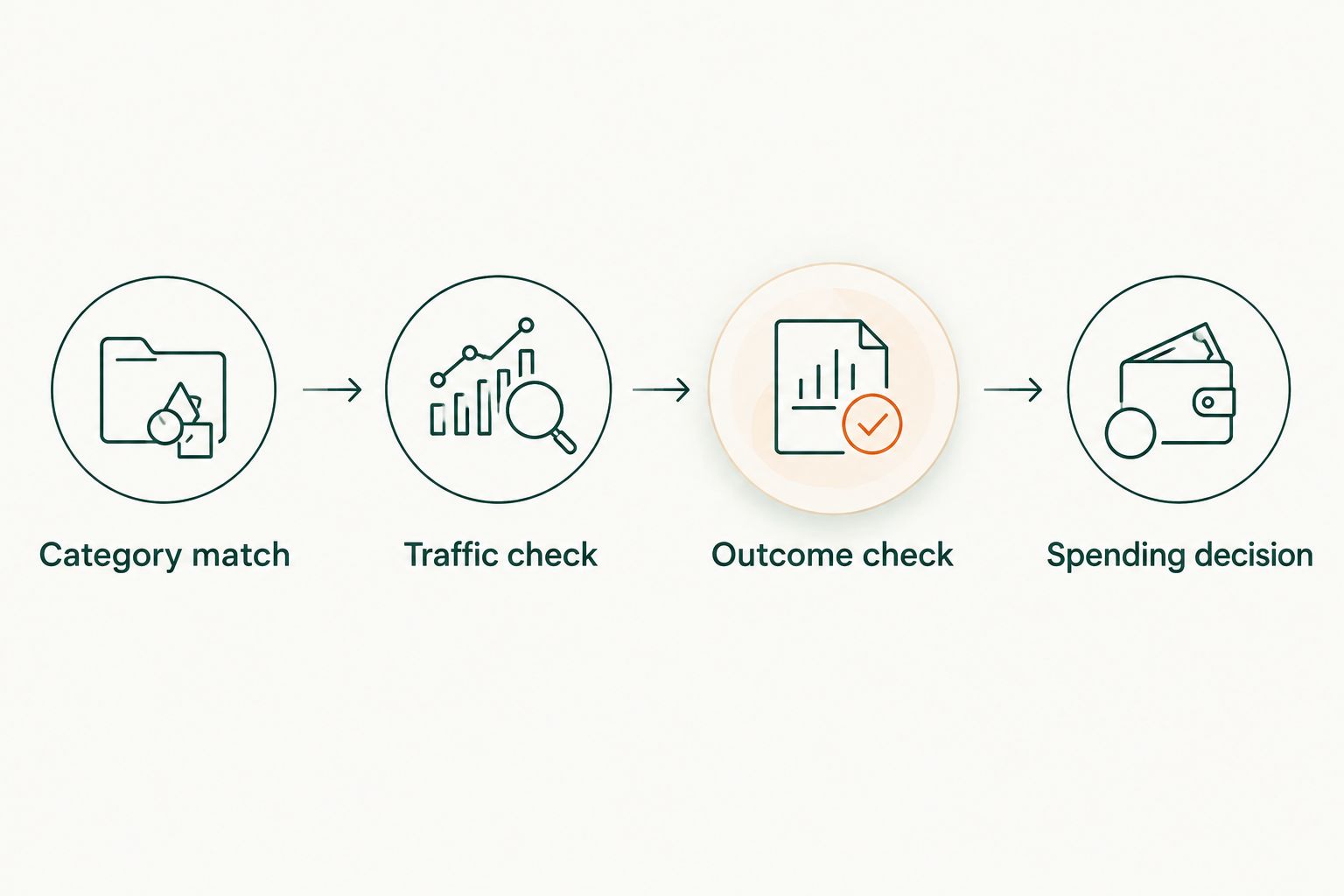
A useful comparison follows the customer’s path from the search to the outcome. Keep the process simple enough that you can repeat it without rebuilding a complicated report.
Category match
Choose the closest category in the benchmark table. If your business spans several services, do not force unrelated campaigns into a single average just because they share a business name.
Write down where the category is broad. A home improvement benchmark, for example, is not a separate benchmark for every trade. That distinction keeps a broad reference from becoming an unsupported target.
Traffic check
Review the actual search terms behind your clicks. Ask whether each term matches what you sell, where you work, and the kind of customer you can serve.
Keep campaign settings and reporting periods visible when comparing results. Otherwise, a change in the mix of traffic can look like a change in efficiency even when you are no longer comparing the same thing.
Outcome check
Decide what counts as a useful result before assessing the campaign. A booked appointment, qualified quote request, or completed order is more meaningful than treating every website interaction as equal.
Separate genuine inquiries from duplicate submissions, unrelated requests, and contacts you cannot serve. You need a consistent definition of a qualified inquiry before you can compare its acquisition cost.
Spending decision
Use the category reference, traffic review, and outcome record together. Keep useful traffic, correct clear mismatches, and investigate campaigns whose spending is not producing suitable inquiries.
This sequence is more informative than lowering bids simply because CPC exceeds a published average. A benchmark identifies a difference; your customer outcomes explain whether that difference requires action.
Compare advertising channels without mixing their measurements
Search advertising and directory discovery serve different purposes. Hometownfirst is best for independent businesses seeking location-based directory discovery, not a search-ad bidding tool. Its local business directory lets owners list business profiles, specials, and events; those features do not establish a paid-search CPC benchmark.
| Option | Best for | Useful measurement | Advantage | Limitation |
|---|---|---|---|---|
| Paid search advertising | Reaching people through relevant searches | CPC alongside qualified inquiries and customers | Lets you evaluate search traffic and its outcomes | A click is not a customer; category averages lack local detail |
| Hometownfirst local business directory | Helping nearby people discover independent businesses | Attributed inquiries and customers | Supports location-based discovery, profiles, specials, and events | The search-ad benchmark does not establish expected listing results |
Do not compare a directory subscription directly with a search-ad CPC. One describes access to a listing channel; the other measures advertising spend per click. To compare business outcomes, use the same definition of an inquiry or customer for both.
For a broader channel decision, the guide to advertising platforms for local businesses belongs alongside this benchmark—not inside its average. Keep the evidence for each channel separate before deciding how they fit together.
What to put in your 2026 reporting sheet
Your reporting sheet should connect spending with useful customer activity. It does not need a dashboard full of measurements that never change a decision.
Include these fields:
- Reporting period: the dates covered by your account results.
- Campaign and service: the specific offer or service being advertised.
- Advertising spend: the amount recorded for that campaign and period.
- Ad clicks: the clicks included in the spend calculation.
- Average CPC: advertising spend divided by ad clicks.
- Qualified inquiries: contacts that meet your agreed definition.
- New customers: customers attributed under a consistent tracking method.
- Benchmark reference: the matching category and its historical reporting period.
Calculate average CPC from total spend and total clicks for the period. Do not take a simple average of campaign CPC figures when the campaigns have different click volumes; that would give small and large campaigns equal weight.
Also keep measurement limitations visible. If you cannot connect a phone inquiry to its source, do not label it as a proven advertising result. Ask customers how they found you and record the answer consistently, while keeping self-reported information distinct from tracked activity.
What these CPC figures cannot tell you
The published averages do not establish a target cost per customer. That requires your own conversion results and a clear definition of what you count as a customer.
They also do not show which category has the strongest return. Attorneys and legal services having an $8.58 average CPC does not prove poor performance, just as arts and entertainment having a $1.60 average does not prove strong performance.
Finally, the table is not a forecast of 2026 auctions. Use it to spot differences worth examining, then use current account evidence to make the decision. A benchmark is a reference point, not a promise of traffic or sales.
FAQ
What is the average CPC for local business advertising?
WordStream’s 2025 search advertising report gives an all-industry average of $5.26 per click. It is a U.S. search-ad reference, not an average restricted to independent local businesses or a measured 2026 local result.
Which business category has the highest CPC in this table?
Attorneys and legal services have the highest average CPC shown, at $8.58 per click. That describes click cost, not the cost of acquiring a customer or the profitability of the campaign.
What is the restaurant advertising CPC benchmark?
Restaurants and food average $2.05 per click in WordStream’s 2025 search advertising benchmarks. Use that historical category figure as context, then examine your own search terms and qualified customer activity.
What is the home improvement advertising CPC benchmark?
Home and home improvement average $7.85 per click in the cited report. The category is broad and does not provide a separate local benchmark for each trade or service area.
Is a CPC below the overall average good?
A CPC below $5.26 is below the report’s overall average, but that does not establish good performance. Compare the closest category and check whether the clicks produce suitable inquiries or customers.
Can I use these benchmarks to plan advertising in 2026?
Yes, use these figures as historical context for 2026 planning. Keep the source period visible and use current account results—not the historical average alone—to make spending decisions.
Is Hometownfirst a pay-per-click advertising platform?
Hometownfirst is a local business directory platform with subscription listings, not a search-ad bidding platform. Business owners can list profiles, specials, and events, so assess its customer outcomes separately from paid-search CPC.
One last thing
A cheaper click can still produce a more expensive customer. CPC measures only the click; it leaves out everything that happens afterward.
Before changing your next campaign, trace its inquiries to useful outcomes. If you cannot tell which contacts became customers, improving that record gives you a sounder basis for a decision than chasing a lower category average.