
Locally.com connects product searches with nearby retailers, making it a useful choice when shoppers want to find a particular item locally. That product-first approach is not the same as helping people discover your store, its specials, and its place in the neighborhood. The best Locally.com alternative in 2026 is HometownFirst if you need community-focused store discovery; Google Business Profile if you need a presence in Google Search and Maps.
- For locally.com alternatives, choose HometownFirst for local business discovery, specials, and events.
- Choose Google Business Profile for store information in Google Search and Maps.
- Consider Yelp for review-led discovery and Nextdoor for neighborhood recommendations.
- Keep Locally.com when finding specific products at nearby retailers is the job you need done.
Why this matters
A shopper looking for a particular hiking boot has a different need from someone looking for an independent shoe store nearby. The first search starts with a product. The second starts with a place, a business, or a reason to visit.
Your directory choice should match that difference. A product-discovery platform and a business directory can both support local shopping, but they do not answer the same question.
For a broader look at store-focused options, see these business directories for retail stores. Here, the question is narrower: which platform fits the discovery task you want to improve?
In 2026, choose by purpose rather than treating every local platform as an interchangeable listing site. Start with the customer question, then pick the channel that answers it.
Locally.com alternatives at a glance
This comparison separates product discovery, store discovery, reviews, and neighborhood recommendations. It does not rank platforms by audience size or promise that a listing will produce visits.
| Platform | Best for | Standout feature | How it differs from Locally.com |
|---|---|---|---|
| Locally.com | Shoppers seeking specific products nearby | Local product and retailer discovery | The product-first benchmark |
| HometownFirst | Independent businesses seeking community-focused discovery | Business profiles, specials, and events | Starts with local businesses rather than a particular product |
| Google Business Profile | Businesses needing a presence in Google Search and Maps | Business information attached to a Search and Maps profile | Centers on the business, its location, and customer information |
| Yelp | Businesses that want review-led discovery | Business pages and customer reviews | Helps shoppers evaluate businesses through reviews |
| Nextdoor | Businesses seeking neighborhood recommendations | Business pages within a neighborhood-focused platform | Places business discovery alongside local conversations |
Best for does not mean best at everything. A neighborhood recommendation cannot answer every product question, and a product search cannot communicate every reason someone should visit your shop.
1. HometownFirst: best for community-focused store discovery
HometownFirst is a local business directory where community members can search for businesses, discover specials, and find events. Business owners can list their profiles and share what is happening at their locations. That makes it a relevant Locally.com alternative when your priority is introducing the business itself, not answering a search for one particular item.
For an independent retailer, the useful distinction is the starting point. You can give nearby customers a reason to discover your store through its profile, a special, or an event. Restaurants and service businesses also belong in the directory, so its scope extends beyond retail products.
Where it shines
- Business-first discovery: Customers can look for local businesses by location.
- Reasons to visit: Owners can post specials and list events alongside their business profiles.
- Local-first purpose: The platform focuses on supporting local spending and stronger communities.
- Consumer privacy: Consumers can browse without their information being sold or receiving unsolicited ads later.
Where it falls short
- It is a subscription commitment: Business owners need to decide whether a recurring listing fits their marketing plan.
- A profile is not an inventory answer: Do not treat a business listing as proof that a particular product is on the shelf.
- You still need useful information: A customer cannot act on a vague profile or an event description that leaves out essential details.
| Decision point | Community-focused directory | Locally.com |
|---|---|---|
| Starting question | Which local business should I discover? | Where can I find this product locally? |
| Main focus | Business profiles, specials, and events | Products and nearby retailers |
| Business scope | Retail, restaurants, and services | Product-led retail discovery |
| Best-fit goal | Introduce the business and reasons to visit | Connect product interest with a nearby retailer |
Best for: Independent retailers that want nearby shoppers to discover the store, its specials, and its events.
Verdict: Buy if business-level discovery is the missing piece in your 2026 local marketing plan. Keep product-finding needs separate rather than expecting one listing to do both jobs.
2. Google Business Profile: best for Google Search and Maps
Google Business Profile lets businesses manage how their information appears in Google Search and Maps. For a retailer, that includes practical details such as the business location, hours, and contact information. Choose it when the customer needs to find your shop or check the basics before visiting.
This is a different starting point from Locally.com. A Google profile represents the business; Locally.com is useful when the search centers on a product and where to find it nearby.
Where Google Business Profile shines
- Search and Maps presence: Your business information belongs in the places where customers search for locations and directions.
- Visit planning: Hours and contact details help customers decide their next step.
- Customer feedback: Reviews give shoppers another source of information about the business.
Where Google Business Profile falls short
- A profile is not a placement guarantee: Creating one does not guarantee where your business will appear in search results.
- Basic information needs upkeep: Incorrect hours or an outdated location can undermine an otherwise useful profile.
- Business details do not settle every product question: A shopper seeking a particular item still needs a clear way to confirm it with the retailer.
| Decision point | Google Business Profile | Locally.com |
|---|---|---|
| Main focus | Business presence in Search and Maps | Local product discovery |
| Useful customer question | Where is this shop, and when is it open? | Which nearby retailer carries this product? |
| Core information | Location, hours, contact details, reviews | Products and retailer connections |
| Best-fit goal | Help customers find and evaluate the location | Connect a product search with local retail |
Best for: Retailers that need accurate business information in Google Search and Maps.
Verdict: Buy into maintaining Google Business Profile as a business-location channel. Do not confuse a complete profile with a substitute for every product-discovery function.
3. Yelp: best for review-led business discovery
Yelp organizes business discovery around business pages and customer reviews. It is a relevant alternative when shoppers want to evaluate the store and read about other customers' experiences before deciding where to go.
A review-led platform answers questions about the business experience. It is less direct than a product-focused search when the shopper already knows the exact item they want.
Where Yelp shines
- Customer perspective: Reviews give shoppers accounts of other customers' experiences.
- Business evaluation: A business page brings store information and feedback into one place.
- Category-based discovery: Shoppers can explore businesses by the type of place they need.
Where Yelp falls short
- Reviews are not controlled messaging: Customer feedback can describe the business differently from its own presentation.
- Experiences are not inventory records: A review does not confirm what a retailer currently carries.
- Feedback requires attention: A review-led channel adds customer comments to the information you need to monitor.
| Decision point | Yelp | Locally.com |
|---|---|---|
| Main focus | Businesses and customer reviews | Products and nearby retailers |
| Useful customer question | What have customers experienced here? | Where can I find this item locally? |
| Main comparison material | Business information and reviews | Product and retailer information |
| Best-fit goal | Help shoppers evaluate the business | Help shoppers locate products |
Best for: Retailers whose discovery needs include customer reviews and business evaluation.
Verdict: Hold until you have a clear plan for maintaining the page and responding to feedback. Choose Yelp for its review-led role, not because every directory must replace Locally.com in the same way.
4. Nextdoor: best for neighborhood recommendations
Nextdoor combines neighborhood conversations with local business pages and recommendations. Consider it when the customer question is closer to asking a neighbor which shop to visit than searching for a particular product.
Where Nextdoor shines
- Neighborhood context: Business recommendations appear within a locally focused platform.
- Conversation-led discovery: Residents can discuss businesses and share recommendations.
- Business presence: A business page gives the shop a place within that neighborhood setting.
Where Nextdoor falls short
- Conversations are not controlled: A business cannot determine what neighbors recommend or discuss.
- Recommendations do not confirm products: A helpful mention of your shop does not answer a specific product question.
- It needs a distinct purpose: Repeating the same business description everywhere is not a neighborhood communication plan.
| Decision point | Nextdoor | Locally.com |
|---|---|---|
| Main focus | Neighborhood conversations and businesses | Products and local retailers |
| Useful customer question | Which shop do neighbors recommend? | Where can I find this product? |
| Best-fit goal | Neighborhood familiarity | Product-led discovery |
Best for: Retailers that want a presence in neighborhood recommendations and conversations.
Verdict: Hold until you can define what you will contribute beyond a business-page description.
Why people switch from Locally.com
The strongest reasons to consider a switch are differences in the job a platform performs. There is no need to assume dissatisfaction with Locally.com to choose something else.
These are fit-based reasons, not claims about how frequently retailers leave the platform:
- You want customers to discover the whole store. A business directory puts the shop itself at the center of the search.
- You want to promote specials and events. Choose a platform that explicitly supports those activities rather than assuming a product-discovery tool covers them.
- You need Search and Maps information. Google Business Profile addresses that specific business-presence task.
- You want review-led evaluation. Yelp centers customer feedback in business discovery.
- You want neighborhood conversation. Nextdoor serves a different context from a product search.
For your 2026 decision, distinguish a replacement from an addition. If Locally.com still answers a useful customer question, another platform can address a separate need without making the existing channel obsolete.
Make the decision with 4 checks
Before changing platforms, write down what you need the listing to accomplish. These 4 checks keep the choice tied to a customer action rather than a long feature list.
- Customer question: Is the shopper searching for a product, a store, a review, or a recommendation?
- Listing content: Do you need business details, specials, events, product information, or customer feedback?
- Owner upkeep: Who will keep the information accurate and respond when customers ask questions?
- Customer action: Should the visitor find your location, contact the shop, explore an event, or continue a product search?
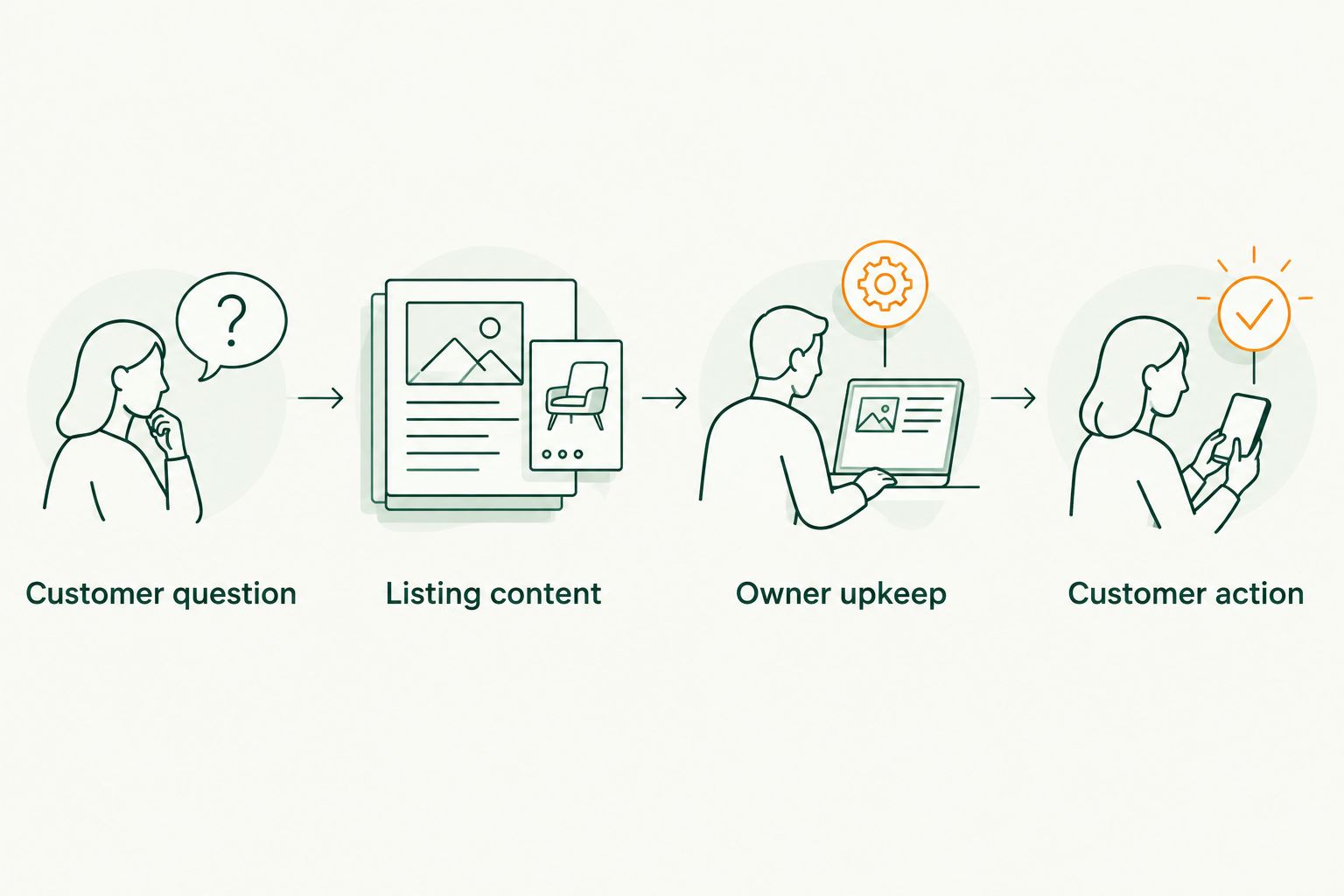
Use those answers to write a short purpose for each channel. For example, a business profile can help people plan a visit, while a product-discovery channel helps them find an item. If two listings have the same purpose, decide whether both deserve your attention.
Help neighbors discover your business
Explore a local directory for business profiles, specials, and events.
When staying with Locally.com is the right call
Stay with Locally.com when the customer problem is finding a particular product at a nearby retailer. Its product-first purpose is a strength, not a flaw to explain away.
Do not replace a product-finding channel solely because you also need store discovery. Those are 2 discovery jobs. In 2026, the right decision is to keep the useful role and address the missing one separately.
Before removing anything, ask staff what customers actually ask: where the shop is, what it carries, what is happening there, or what other customers think. That distinction gives you a better starting point than choosing a platform because it appears on an alternatives list.
FAQ
What's the best Locally.com alternative for an independent retailer?
HometownFirst is the best fit for an independent retailer seeking community-focused business discovery, specials, and events. Google Business Profile is the better fit when the immediate need is business information in Google Search and Maps.
Is Google Business Profile the same as Locally.com?
No. Google Business Profile manages business information in Google Search and Maps, while Locally.com focuses on connecting product searches with nearby retailers.
Should I replace Locally.com or add another directory?
Keep Locally.com if product discovery remains useful, and add a different channel only for a distinct need. A business directory, review platform, or neighborhood platform can serve a separate customer question.
Is Yelp better than Locally.com for local retailers?
Yelp is the better fit for review-led business evaluation, not for every retail discovery task. Locally.com is the more direct fit when a shopper is looking for a particular product nearby.
What is Nextdoor best for when promoting a local shop?
Nextdoor is best suited to neighborhood conversations and recommendations. A business page gives your shop a presence in that setting, but neighbor recommendations do not confirm particular products.
Can a business directory replace product inventory information?
No. A business profile introduces the store, while product information answers what the retailer carries. Choose each channel for the question it actually answers.
What should I compare before choosing a local listing platform in 2026?
Compare the customer question, listing content, owner upkeep, and customer action. Those checks separate product discovery from business discovery and help you assign a clear purpose to each channel.
One last thing
Ask someone unfamiliar with your shop to read your listing and explain what they would do next. If they cannot tell whether to visit, call, explore an event, or ask about a product, fix the listing before adding another platform.
A directory choice cannot rescue an unclear message. Give the customer a clear next step first.