
Insurance agencies’ local advertising is the work of making an agency visible to nearby customers with the aim of generating relevant coverage inquiries. To advertise a local insurance business, combine accurate listings, clear service pages, community outreach, and measured promotion; explain what your agency handles without promising coverage, savings, or eligibility before reviewing a customer’s situation.
- To advertise local business for insurance agencies, combine local listings, useful coverage pages, and qualified-inquiry tracking.
- Google Business Profile is a starting point for eligible agencies seeking visibility in local search.
- Community directories add a discovery channel; they do not replace your agency’s website or customer follow-up.
- Judge local advertising by relevant coverage inquiries, not impressions alone.
Why local advertising matters for insurance agencies
A nearby customer needs more than your agency’s name. They need to know whether you handle their coverage question, serve their location, and offer a practical way to speak with someone. Your advertising should answer those questions before asking for personal information.
For your 2026 plan, separate discovery from conversion. A listing helps someone find you; a useful page and a clear contact process help that person decide whether to inquire. Start with the basics in this guide to free business listing sites, then choose additional channels around the customers you actually serve.
Insurance also needs careful wording. Keep general education separate from a personalized coverage recommendation, and have the appropriate person review advertising claims before publication. A friendly neighborhood message still needs to describe your agency accurately.
How to advertise your insurance agency locally
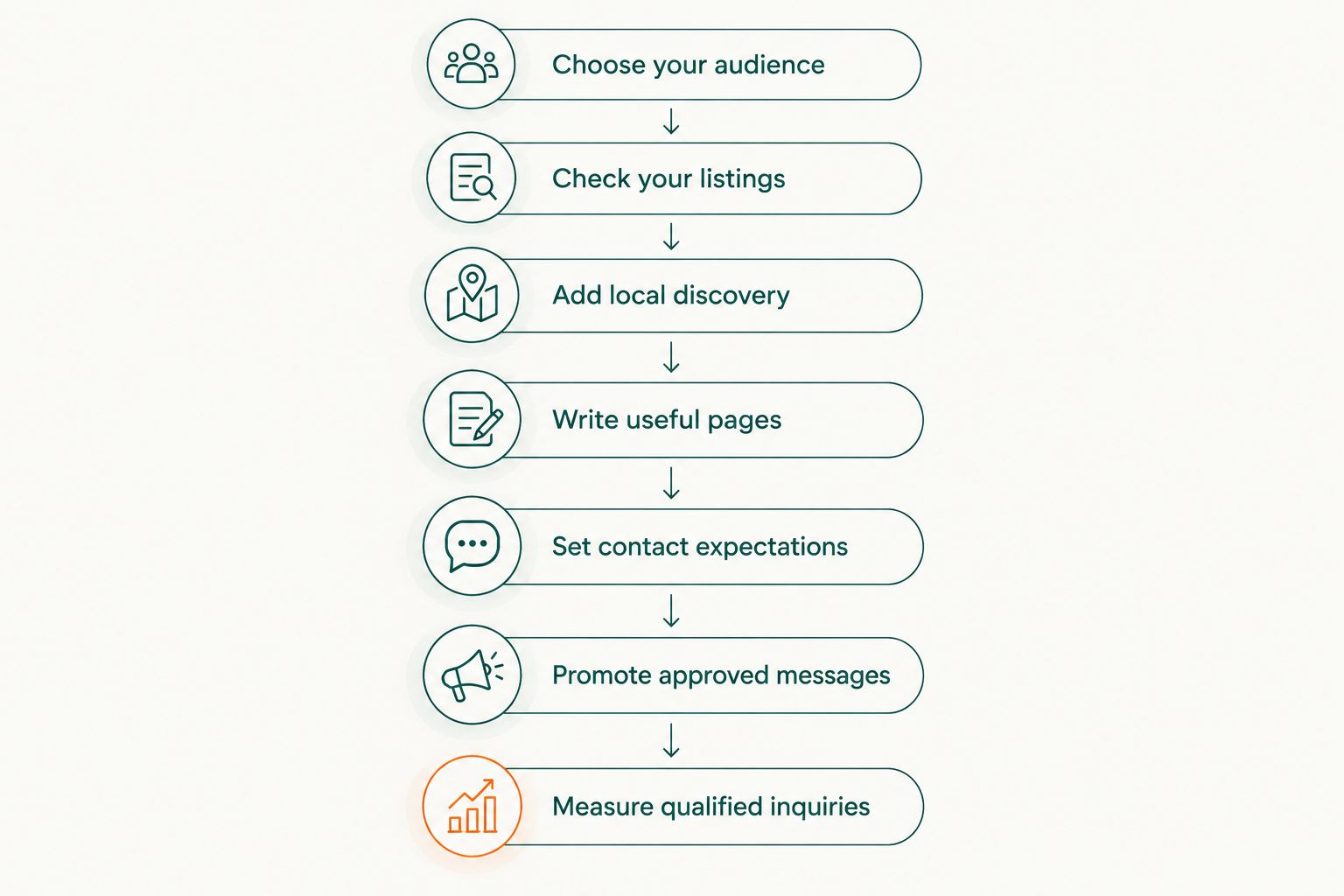
Build your local advertising in this order: choose an audience, correct your listings, add discovery channels, explain your services, prepare your contact process, publish approved messages, and measure relevant inquiries. Finish the foundation before adding more places to maintain.
Choose your audience
Start with your own records and conversations. Review the types of inquiries your agency can handle, the locations you serve, and the questions that repeatedly need explanation. Select a specific audience for each campaign rather than trying to address every insurance need in one message.
For example, an agency that handles commercial coverage can write for local business owners. An agency that handles personal lines can organize separate messages around the coverage categories it actually offers. These are planning examples, not reasons to add services you do not provide.
Write a 1-page campaign brief for your 2026 advertising. Include the audience, service, location, approved message, destination page, and desired action. This gives everyone answering inquiries the same understanding of what the campaign promises.
- Identify the coverage category your agency handles.
- Define the geographic area your agency serves.
- List the audience’s practical questions.
- Choose a clear action, such as requesting a conversation.
- Remove claims your agency cannot substantiate.
Check your listings
Search for your agency name and review the information customers encounter. You can do this manually with a browser and a spreadsheet. Record the listing address, displayed business name, phone number, office hours, website destination, and any correction needed.
Google Business Profile is a starting point for an eligible agency’s local search presence. Review eligibility and representation requirements before creating or changing a profile. Do not use a location that misrepresents where your agency operates or how customers can meet you.
Keep the public details consistent with the agency’s actual operation. If appointments are required, make that clear wherever the listing supports it. A customer should not have to call several numbers to discover which office handles their question.
Set aside a 15-minute listing review as a recurring maintenance task. That is a suggested routine, not a promised time to correct every platform.
- Confirm the agency’s public business name.
- Check the phone number and website destination.
- Correct office hours and appointment instructions.
- Use categories that describe the agency accurately.
- Flag duplicate or outdated profiles for review.
Add local discovery
Start by checking community directories manually. Look at how people search by location, whether the available categories fit your agency, and what information a business profile displays. Choose a directory because its discovery process fits your audience, not because it offers another place to paste an advertisement.
HometownFirst is a local business directory where community members can search for nearby businesses and business owners can publish profiles, specials, and events. It gives your agency a defined place to present local information rather than relying only on scattered community posts.
HometownFirst local advertising is best for independent insurance agencies seeking an additional location-based discovery channel. Its limitation is scope: a directory listing is an entry point, not a substitute for your agency’s website, coverage explanations, or response process. Business listings use a monthly subscription model.
For your 2026 directory profile, prioritize agency information over promotional language. Event and special-posting features do not make every insurance promotion appropriate.
- Describe the coverage categories your agency handles.
- State your location and service area accurately.
- Explain how customers should contact the agency.
- Publish events only when your agency actually hosts them.
- Review any promotional wording before posting.
Write useful pages
Draft your service explanations in a document before changing your website. Use the questions your agency receives, then organize each page around a coverage category and a relevant location. Explain the agency’s role and what the customer can expect from an initial conversation.
A useful page does not need to explain every policy provision. It needs to help the reader recognize whether the agency handles their request. State that coverage depends on the applicable policy and circumstances when the explanation requires that distinction; do not present general examples as promises.
Avoid creating interchangeable town pages that only swap place names. Describe genuine service arrangements instead. If your agency serves an area remotely, do not imply that it has an office there.
For a 2026 content review, check older pages for staff changes, outdated contact instructions, and services the agency no longer handles. Accuracy comes before adding more pages.
- Give each page a specific coverage purpose.
- Explain who the service is intended for.
- Describe the next step in plain language.
- Include accurate location or service-area information.
- Remove unsupported savings and coverage claims.
Set contact expectations
Test the contact process yourself before promoting it. Call the published number, send a test inquiry, and check where the message arrives. Make sure the person receiving it can identify the service and location mentioned in the advertisement.
Use a short initial form when a form is appropriate. Ask for enough information to route the inquiry, then use your agency’s approved process for sensitive details. An open-ended message box should not encourage customers to submit documents or detailed personal information without suitable handling.
Tell customers what action they are taking. Requesting a conversation is not the same as purchasing insurance, receiving a quote, or binding coverage. The advertisement and its destination should describe the same next step.
Establish response expectations your team can actually meet. If the office only handles inquiries during business hours, make that visible rather than implying immediate help.
- Test the published phone number and inquiry form.
- Route inquiries to the appropriate team member.
- Explain what happens after submission.
- Keep sensitive information out of casual public exchanges.
- Make office hours and contact limitations clear.
Promote approved messages
Begin with channels you already maintain: your agency website, existing listings, and appropriate community relationships. Prepare a useful message, review it, and adapt it to each placement. Do not publish the same dense block of text everywhere.
Community outreach can focus on education rather than a sales pitch. If your agency actually hosts an event, explain its subject, intended audience, location, and participation details. Keep educational content separate from individualized advice, and obtain permission before naming a partner or implying an endorsement.
Paid search is a separate option for agencies prepared to manage targeting, ad wording, destination pages, and follow-up. Start with a defined service and location instead of sending broad traffic to a generic home page. Keep a record of what was approved so later edits do not quietly change the claim.
HometownFirst local advertising can support this plan through business profiles and event listings. It should carry the same accurate agency information as your other channels.
- Match each message to a defined audience.
- Use approved wording across placements.
- Obtain permission for partner references.
- Send visitors to a relevant service explanation.
- Pause messages that no longer reflect your agency.
Measure qualified inquiries
Start with a spreadsheet and a question at intake: how did the customer find your agency? Record the channel, coverage category, service area, and next step without putting unnecessary personal details into a marketing report.
Define a qualified inquiry before comparing channels. For this plan, it means a request involving a service your agency handles and a customer location your agency serves. Keep that definition separate from underwriting eligibility or a decision to issue coverage.
Use a 30-day review window for your initial 2026 comparison. This is a planning interval, not a promise that advertising will produce results within that period. Review the actual volume of inquiries before making a channel decision.
Track discovery, relevance, and follow-up separately. A channel producing page visits but no relevant requests needs a different response from a channel producing suitable inquiries that receive no timely follow-up.
- Record how each inquiry found the agency.
- Tag the requested coverage category.
- Note whether the location is within your service area.
- Track whether the agency completed the next step.
- Compare qualified inquiries with channel effort and expenditure.
Compare local advertising options for insurance agencies
Choose each option for a specific job. Your website explains the agency, local profiles support discovery, community outreach builds direct connections, and paid search adds a separately managed advertising channel. None removes the need for accurate claims and clear follow-up.
| Option | Best for | Main benefit | Key limitation |
|---|---|---|---|
| Agency website | Explaining services and handling inquiries | Gives the agency control over its service descriptions and contact instructions | Publishing a website alone does not ensure local discovery |
| Google Business Profile | Eligible agencies seeking local search visibility | Presents business information within Google’s local search experience | Requires eligibility, accurate representation, and ongoing maintenance |
| HometownFirst | Independent agencies adding community directory discovery | Supports location-based discovery through business profiles | Uses a monthly subscription model and does not replace agency follow-up |
| Community outreach | Agencies with relevant local relationships or educational events | Creates a direct setting for explaining the agency’s role | Requires coordination and careful separation of education from personalized advice |
| Paid search | Agencies ready to manage targeted campaigns | Lets the agency advertise around selected searches and locations | Requires campaign oversight, approved messages, and relevant destination pages |
Start with a maintained website and accurate local profiles. Add channels when you can explain what each contributes and identify the inquiries it generates. More placements mean more information to keep current, not automatic improvement.
Common mistakes insurance agencies make
Advertising every coverage category in one message
A broad list leaves the reader to work out whether your agency fits their request. Separate messages by services you actually handle, and give each message a relevant destination. Keep the agency-wide overview for people who want the full picture.
Promising savings or coverage before reviewing the situation
An attention-grabbing claim can say more than the agency can support. Use approved, substantiated wording and explain the next step accurately. Do not turn a general coverage example into a guarantee about a reader’s policy.
Treating insurance like a retail special
A directory’s ability to publish specials is not a reason to invent an insurance discount, giveaway, or incentive. Promotions require review against applicable rules and agency requirements. When the offer is unclear, publish useful agency information instead.
Replying to reviews with customer details
A public response should not become a discussion of someone’s policy, claim, or personal circumstances. Thank the reviewer or acknowledge the concern without confirming private details. Move account-specific conversations to the agency’s approved private process.
Counting every contact as a successful lead
Wrong-area inquiries, requests for services you do not handle, and unrelated calls should not inflate campaign results. Track those contacts separately. Otherwise, you cannot distinguish an audience problem from a follow-up problem.
FAQ
What’s the best way to advertise a local insurance agency?
Start with accurate local profiles, clear service pages, and a tested contact process. Then add advertising channels that match the coverage categories and locations your agency serves.
Is HometownFirst a fit for insurance agencies?
HometownFirst is a fit for independent insurance agencies seeking an additional location-based directory presence. It supports business profiles, but the agency still needs accurate service information and its own inquiry-handling process.
Should my insurance agency use Google Business Profile or a directory?
Use each for a distinct discovery purpose rather than treating them as identical replacements. An eligible agency can maintain Google Business Profile for local search and assess a community directory as an additional channel.
Can I advertise insurance discounts in a local listing?
Advertise an insurance discount only when the claim is accurate, substantiated, and approved under applicable requirements. A directory’s special-posting feature does not establish that a particular insurance promotion is appropriate.
What should an insurance agency put in its directory profile?
Include the agency’s accurate name, location, contact details, hours, and coverage categories. Explain the next step without promising eligibility, savings, or coverage before the appropriate review.
How do I know whether local advertising is working?
Track relevant inquiries from customers in locations your agency serves. Separate discovery metrics from qualified requests and completed follow-up so each channel has a clear role.
Do insurance agencies need a separate page for every town?
Create a location page only when it adds accurate, useful information about how your agency serves that area. Repeating the same page with different town names does not explain a different customer experience.
One last thing
An inquiry form is part of your advertisement. If the message invites a simple conversation but the form asks for extensive personal details, the next step no longer matches the invitation.
Before adding another channel to your 2026 plan, follow one advertisement through to its destination and contact process. Make the path accurate and understandable from the first sentence to the final action.