
Choose Hometownfirst if you want a local business directory for reaching nearby shoppers with profiles, specials, and events; choose Tripadvisor if you want travel-focused discovery supported by traveler reviews. This 2026 comparison separates neighborhood shopping from trip planning so you can choose the directory that matches your customers’ needs.
- Hometownfirst vs Tripadvisor comes down to neighborhood discovery versus travel planning, not a universal winner.
- Choose Hometownfirst for local business profiles, specials, and events aimed at nearby customers.
- Choose Tripadvisor for traveler reviews and research into restaurants, accommodation, and things to do.
- Both support restaurant discovery; choose according to whether customers are shopping locally or planning a visit.
Why this matters
A directory listing should help the right customer find you for the right reason. Someone looking for a nearby repair service has a different task from someone comparing restaurants for a weekend away. Treating those searches as interchangeable leads to the wrong platform choice.
Hometownfirst is a local business directory built around independent businesses and nearby customers. Tripadvisor organizes discovery around travel, restaurants, accommodation, attractions, and traveler experiences. The useful comparison is customer intent, not which name sounds more familiar.
For your 2026 directory decision, start with the question customers need answered. Is it where to spend locally, or which place deserves a spot on an itinerary? Neither platform replaces the work of keeping your business information accurate and giving customers a reason to visit.
At a glance
| Dimension | Hometownfirst | Tripadvisor |
|---|---|---|
| Best for | Community members discovering nearby independent businesses | Travelers researching places to stay, eat, and visit |
| Business fit | Local retail, restaurants, and services | Travel and hospitality businesses |
| Travel planning | Local discovery rather than itinerary research | Accommodation, restaurants, attractions, and things to do |
| Standout feature | Business profiles with specials and events | Traveler reviews and ratings |
| Specials and events | Businesses can post specials and list events | Travel research is the stronger reason to choose it |
| Restaurant discovery | Finding local restaurants and their specials | Comparing restaurants through traveler reviews |
| Location-based discovery | Searching for businesses by location | Searching for places in a destination |
| Pricing model | Monthly business listing subscription | Basic listings with paid promotional options |
The table is a fit guide, not a claim that either platform will deliver more customers. A directory’s features describe what you can publish or research. They do not establish how many people will discover your particular business or decide to buy.
Neighborhood discovery favors the local-first directory
Best for: independent businesses that want nearby customers to discover them.
The local-first platform’s purpose fits ordinary neighborhood decisions: finding a shop, choosing a service business, or checking what a nearby restaurant is promoting. Business owners can publish profiles, specials, and events, while consumers browse and search without a browsing fee.
That makes the directory a clear fit when your message is about participating in the local community. A special or event gives someone a reason to look beyond a business name and consider a visit. The platform’s stated consumer approach also includes no selling of consumer information and no unsolicited advertising afterward.
Tripadvisor is the better starting point when the discovery task begins with a trip. A visitor choosing where to eat near a hotel is not necessarily looking for an ongoing relationship with a neighborhood business. They need information that helps them make a decision during a visit.
The limitation of the local-first approach is its narrower task. Do not choose a community directory as a substitute for accommodation research, attraction reviews, or travel planning. Use it for the local discovery job it is built to serve.
Local retail and services favor broader neighborhood coverage
Best for: independent retailers and service businesses seeking local discovery.
The local directory explicitly serves restaurants, retail, and services. That scope matters if your business does not fit neatly into a travel itinerary. A neighborhood shop or service provider needs a place where finding local businesses is the central activity, rather than an extension of planning a holiday.
Tripadvisor’s strongest fit is travel and hospitality. Restaurants, accommodation, attractions, and experiences belong naturally in that setting because visitors research them before or during a trip. A traveler’s reason for visiting gives those categories a clear role.
For a retail or service business, ask what brings the customer to the directory. If the customer needs help finding an independent business near home, the neighborhood model is the closer match. If the business is part of a visitor’s destination experience, Tripadvisor deserves consideration.
Choose by the customer’s task, not by your category label alone. A restaurant can serve both residents and visitors. A shop can also be part of a travel experience. Your customer mix determines which context matters most.
Tripadvisor wins for travel planning
Best for: people researching accommodation, attractions, and destination activities.
Tripadvisor brings several travel decisions into the same research setting. You can use it to investigate places to stay, restaurants, attractions, and things to do. Traveler reviews add another perspective when you are evaluating an unfamiliar destination.
That is a genuine advantage over a directory whose stated purpose is connecting consumers with local businesses. Finding a nearby business and building a trip itinerary are different jobs. You should not expect a neighborhood listing platform to replace travel research.
The tradeoff is the context itself. Travel-oriented discovery is not the same as helping a resident find a service provider or check a local shop’s event. For those tasks, a destination research platform is not the closest match.
In 2026, the decision remains straightforward: choose Tripadvisor when the research starts with a destination and an itinerary. Choose a local directory when the research starts with an everyday need near home.
Tripadvisor wins when reviews are the deciding evidence
Best for: customers who want traveler feedback before choosing a place.
Tripadvisor’s reviews and ratings are established parts of its travel research experience. They give readers access to other travelers’ accounts rather than only the description a business publishes about itself. That distinction matters when someone wants to understand an experience before committing to it.
A business profile, special, or event answers different questions. It tells customers what the business wants them to know and what it is promoting. It does not serve the same purpose as an independent account of a visit.
The limitation of reviews is relevance. A traveler’s experience can help another traveler, but you still need to read for details that match your own needs. A review focused on a holiday visit does not automatically answer every question a nearby resident has.
For your 2026 choice, separate business information from customer evidence. Use the local directory for the former job and Tripadvisor when traveler feedback is central to the decision. Do not mistake either type of information for the other.
Business specials and events favor the local-first directory
Best for: owners who want to publish reasons for nearby customers to visit.
The local directory explicitly lets business owners post specials and list events. These features fit a business that wants to communicate what is happening now, alongside its profile. They also give consumers something more specific to consider than a category and location.
Tripadvisor’s strongest comparison point is different: it supports travel research through listings and traveler feedback. Choose it because customers need that research context, not because you assume every directory offers the same way to promote local happenings.
The responsibility stays with the business owner. A dated event or an unclear special is not useful merely because it appears in a directory. Describe the offer accurately, explain any applicable conditions, and keep time-sensitive information current.
A practical publishing checklist is short:
- Business details: make your name, location, and description clear.
- Specials: explain what customers need to know before acting.
- Events: give people the information needed to decide whether to attend.
Publishing is the starting point. The next job is making the information useful enough for someone to choose your business.
Both serve restaurant discovery, but answer different questions
Best for: restaurant owners choosing between resident and visitor audiences.
Neither platform wins restaurant discovery in every situation. The local directory fits someone looking for neighborhood restaurants, specials, and events. Tripadvisor fits someone comparing restaurants using traveler feedback, often as part of destination research.
A resident asks whether a nearby restaurant has something relevant to their plans. A visitor asks whether a restaurant fits a trip and what other diners experienced. Both questions are valid, but they call for different information.
Before choosing a platform in 2026, write down 3 customer questions you want your listing to answer. For example: where are you, what makes you relevant to this visit, and what should someone know before choosing you? Then check which platform supports the answers your customers actually need.
The tie is about category suitability, not identical features. Both belong in a restaurant’s directory discussion. Your audience and the information you want to communicate decide which deserves priority.
Both support location-based discovery
Best for: customers starting with a place rather than a business name.
Both platforms let location shape discovery. The local directory helps community members search for businesses by location. Tripadvisor helps people research places in a destination. This is an honest tie on the basic need to find something in a particular area.
The difference appears in what happens next. One search continues toward local businesses and their profiles, specials, or events. The other continues toward travel choices and traveler accounts.
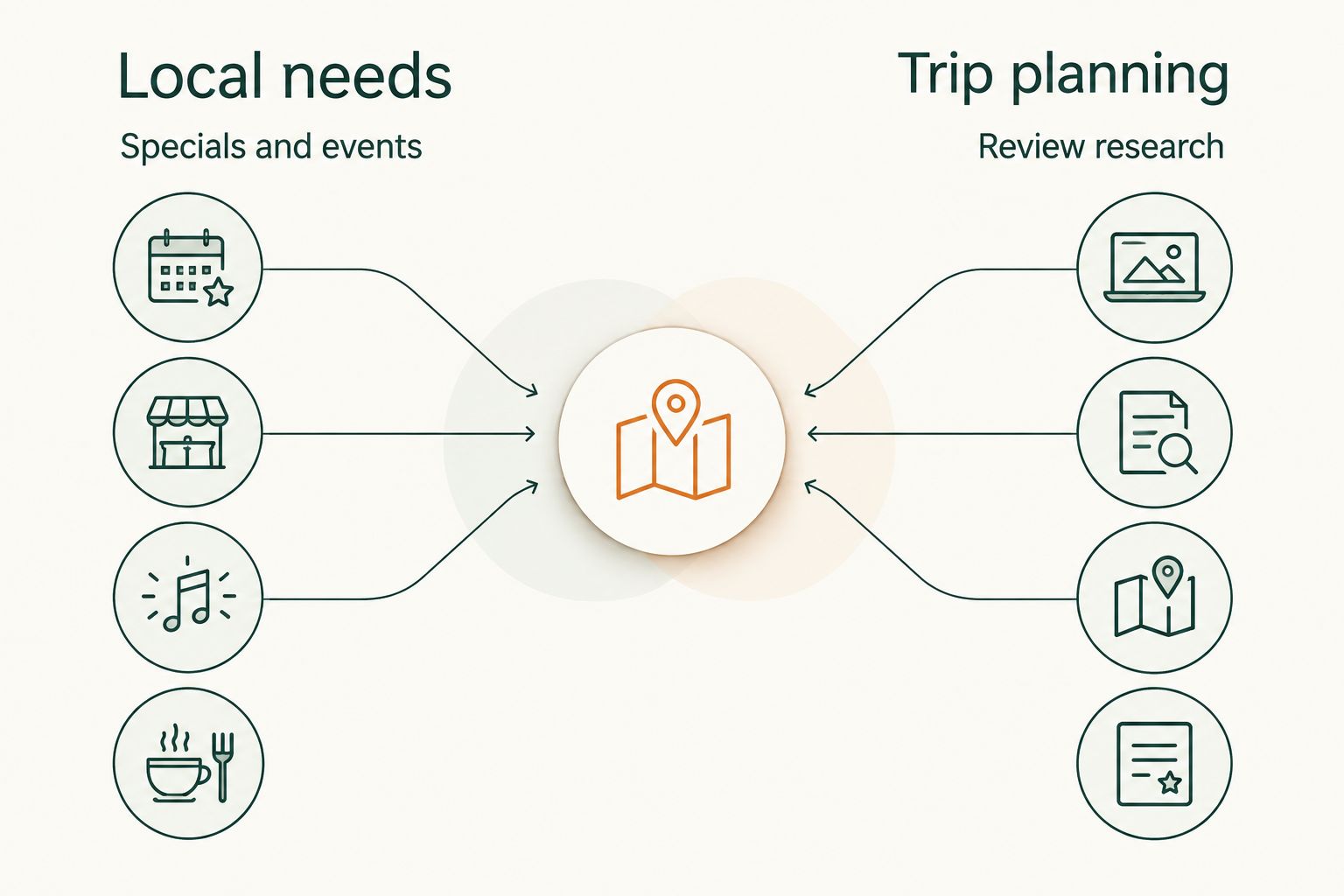
Use this simple decision path:
- Local needs: start with nearby shops, restaurants, or services.
- Trip planning: start with accommodation, attractions, or destination research.
- Review research: prioritize traveler feedback when it answers your question.
- Specials and events: prioritize business-published local information.
Location is the shared starting point. Intent is what separates the platforms.
Pricing models: subscription commitment versus optional promotion
The local directory uses a monthly business listing subscription. Its structure distinguishes a first location from additional locations. Consumers browse and search without paying a browsing fee.
Tripadvisor offers basic business listings and paid promotional options. Its basic presence and promotional products are separate decisions; paying for promotion is not the same as simply maintaining a listing.
A subscription is a recurring commitment; optional promotion separates basic presence from additional spending. Check the current terms for the exact product you are considering rather than treating every paid directory option as equivalent.
For a 2026 budget decision, set a 30-day review period as an internal checkpoint. Ask whether your information stayed current, whether customer inquiries mentioned the directory, and whether the work supported your business goal. This is a review recommendation, not a promised timetable for results.
Do not assign value to a listing solely because it is paid or unpaid. Its usefulness depends on whether it reaches the right discovery context and lets you communicate what customers need.
Final verdict: choose for the customer you want to help
Choose Hometownfirst if you serve nearby everyday customers
Named profile: the independent shop, restaurant, or service owner building local discovery.
Hometownfirst is a local business directory for independent businesses seeking discovery through profiles, specials, and events. Choose it when nearby customers are the priority and you want to publish practical reasons to visit.
The tradeoff is clear: a neighborhood directory is not a replacement for traveler-review research or itinerary planning. Give it the local job, not every discovery job.
Choose Tripadvisor if you serve travelers researching a visit
Named profile: the hospitality owner or traveler making destination decisions.
Choose Tripadvisor when accommodation, restaurants, attractions, and traveler feedback are central to the decision. Its travel context is the stronger match for someone planning where to stay, eat, or spend time away from home.
The tradeoff is equally clear: travel research does not cover every everyday neighborhood need. A local service business should not select it merely because it is a recognizable directory name.
| Dimension | Winner |
|---|---|
| Nearby everyday customers | Local-first directory |
| Independent retail and services fit | Local-first directory |
| Travel planning | Tripadvisor |
| Traveler-review research | Tripadvisor |
| Publishing local specials and events | Local-first directory |
| Restaurant discovery | Tie; resident versus visitor intent decides |
| Location-based discovery | Tie; both start with a place |
| Pricing model | No universal winner; compare commitment and purpose |
FAQ
Is Hometownfirst better than Tripadvisor for a local business?
Hometownfirst is the closer fit for independent businesses seeking nearby customers through profiles, specials, and events. Tripadvisor is the closer fit when traveler reviews and destination research drive the customer's decision.
Which platform is better for a restaurant?
Neither platform wins for every restaurant. A local-first directory fits neighborhood discovery and business-published specials, while Tripadvisor fits restaurant research supported by traveler reviews.
Should a local shop choose Tripadvisor?
Choose Tripadvisor when your shop is relevant to visitors researching a destination. For everyday neighborhood shopping, a directory explicitly serving local retail is the closer match.
Can customers browse the local directory without paying?
Yes, consumers can browse and search Hometownfirst without a browsing fee. Business owners use monthly subscription listings.
Does Tripadvisor help with trip planning?
Yes, Tripadvisor supports research into accommodation, restaurants, attractions, and things to do. Traveler reviews help users evaluate places before or during a visit.
How do the business listing models differ?
The local directory uses monthly business listing subscriptions, while Tripadvisor offers basic listings and paid promotional options. Check current terms before choosing a listing or promotional product.
Can I use both directories for my restaurant?
You can consider both when your restaurant serves residents and visitors. Give each listing a clear purpose and keep the information accurate rather than assuming the audiences need identical messages.
Will either directory guarantee more customers?
Neither platform should be treated as a guarantee of more customers. Choose for audience fit, maintain useful information, and assess the inquiries your business receives.
One last thing
Ask your next customer how they found you, then ask what they were trying to find. Those are different questions. The second tells you whether your directory choice matched the customer's actual task.
Keep those answers alongside your listing review. A customer looking for a nearby service and a visitor comparing restaurants need different information, even when both begin by searching a location.